|
The Acme Brewery of San Francisco was established in 1907 by
Leopold Schmidt, owner of the
Olympia Brewing Company of Tumwater, WA. Acme's story actually
begins with Schmidt's entry into the San Francisco market five years
earlier.
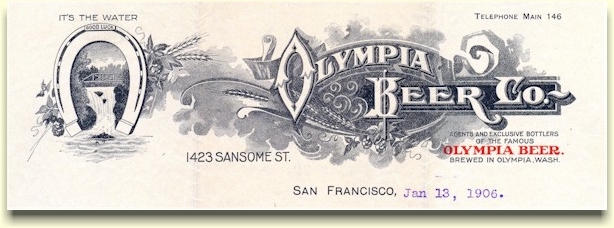
In Oct. 31, 1902, Schmidt hired
Aherns, Pein & Bullwinkel as San Francisco agents for his Olympia
Beer Company. In Feb. 1903, after a limited introduction of his
product, Schmidt shipped 100 casks, each packed with six doz. quarts
of bottled beer, to his agents. This was followed by repeat orders,
creating the certainty that a S.F. market was assured for Olympia
Beer.
Rather than continuing with Aherns, Pein & Bullwinkel for the
distribution of his beer, Schmidt decided to establish his own
agency and bottling works. Schmidt purchased a three lot parcel on
Sansome Street (numbered 1401, 1411, & 1423). The site was located
at the the foot of Telegraph Hill and near the Embarcadero -
convenient to rail and steamship. By November of 1904, construction
had begun on the lot at 1423. On December 31, 1904, an article
appeared in the trade publication, Pacific Wine and Spirit Review,
that described the new agency:
"The Olympia Beer Company have completed their
bottling plant at Sansome and Greenwich streets and will be
delivering Olympia beer bottled and in bulk by January 10th...."
The article went on to describe the building and equipment, which
was state of the art, and that it was under the management of
brothers, Gus and Mitchell Harris. The bottling shop foreman was
Fritz Reither, a nephew of Leopold Schmidt.
The Harris brothers trans-shipped kegs of beer for markets in
California, Nevada, and Arizona, where agents bottled the beer for
local distribution, with their own labels. The Olympia Beer
Company's bottling works provided for the San Francisco market only,
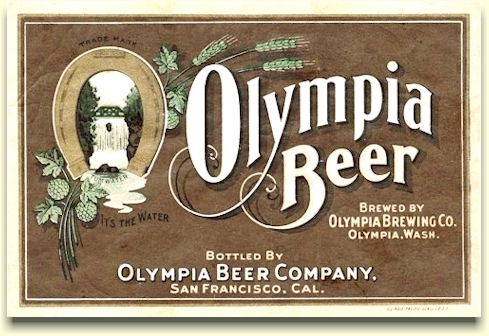
and had a distinctive brown label (below). To promote the
brand in SF, the agency issued an Olympia Beer stein as a
give-away (below).
|
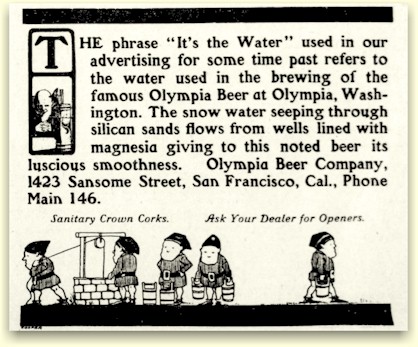
Olympia
Beer ad Apr. 1905 |
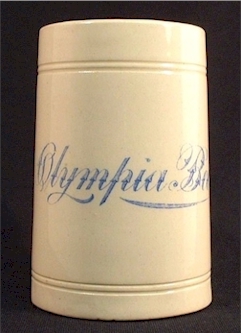
Olympia
Beer stein, ca. 1905
|
The aftermath of the April 18, 1906, fire and earthquake left San
Francisco with few operating breweries, and a beer shortage soon
followed. A $1,000,000 order was then placed with Schmidt's
Bellingham Bay Brewery for beer to be shipped
to the city. His Olympia Beer Company had been spared from the
catastrophe and production had already ramped up at its Tumwater
plant in order to meet the higher demand. Schmidt seized this
opportunity for capturing market share, and set out to build his own
brewery there in the City. He already had the two vacant lots
adjacent to the bottling works (1401-1411 Sansome), so it was a
logical choice.
To oversee this new construction project
Schmidt called upon William Schuldt, who was in management at his
Oregon plant, the
Salem Brewery Ass'n. In addition to Schuldt, a brewer
that had recently joined the Salem organization,
J.P. Rettenmayer, also went to SF. There the two men supervised the
$100,000 plant project, and became principals in the new company.
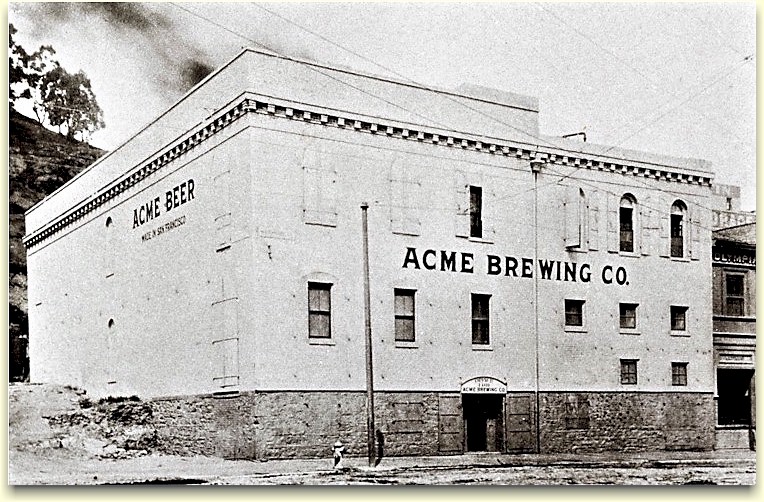
Acme plant - next to the Olympia Beer
Co., c.1907
The Acme Brewery was incorporated on April 11, 1907, with Leopold F.
Schmidt, president; William Schuldt, secretary and manager; and
Jacob P. Rettenmayer, treasurer. J.P. was also Acme's first brewmaster.
Their inaugural label featured the San Francisco waterfront with the
Ferry Building front and center. With the proliferation of
out-of-state beer after the Great Fire & Earthquake of '06, this was obviously an encouragement to buy local.
The label also
shows the brewery's new
phone number as a temporary one. Four months later the August 1907 phone directory list's
the permanent number as Kearny 385.
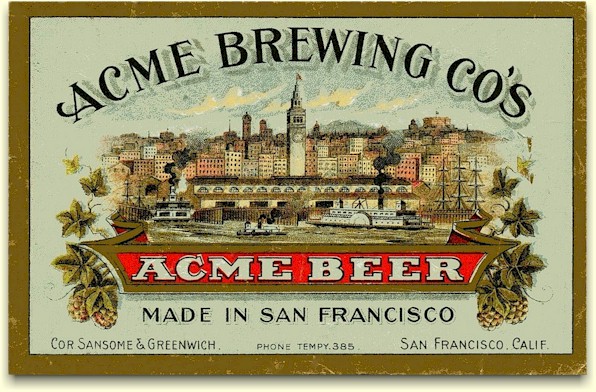
1st Acme label, from the Spring
of 1907
Schmidt may have intended to remove Olympia Beer from the SF market
once the Acme plant's beer was selling well, but in the interim he
kept the bottling works separate from Acme. Consequently, Acme
contracted with a local agent for bottling and distribution of its
output. Schmidt chose this same arrangement for his Bellingham Bay
Brewery. Kegs of beer were shipped to the city and bottled first by
Jos. Cuneo (1903-1905), and then by D.
Meinke until 1910, when 3-B came under new management.
While the Acme Brewery was technically a branch of the Olympia
Brewing Co., it did not produce Olympia Beer. Due to the difference
in water quality, the brew masters could never brew a lager that
equaled that of the Tumwater Plant. Nor was Olympia Beer ever brewed
in the Bellingham, Salem, or Port Townsend plants for the same
reason.
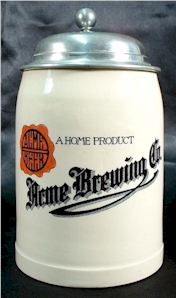 An early promotional piece is shown
here (left). It's Acme's first stein, a Mettlach, ca.1908, made in Germany by Villory & Bosh.
It carried the slogan, "A Home Product" - which they also used in their
print advertising.
These were presented to stockholders and major accounts, and were also given
out as premiums for large purchases. An early promotional piece is shown
here (left). It's Acme's first stein, a Mettlach, ca.1908, made in Germany by Villory & Bosh.
It carried the slogan, "A Home Product" - which they also used in their
print advertising.
These were presented to stockholders and major accounts, and were also given
out as premiums for large purchases.
In May of 1911, JP Rettenmayer¹, now company president and manager, convinced Schmidt that it
was time to annex the bottling works to the Acme Brewing Co. Sales
were up and Olympia Beer's withdrawal would be covered by Acme's
increased production.
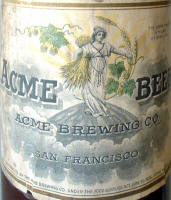
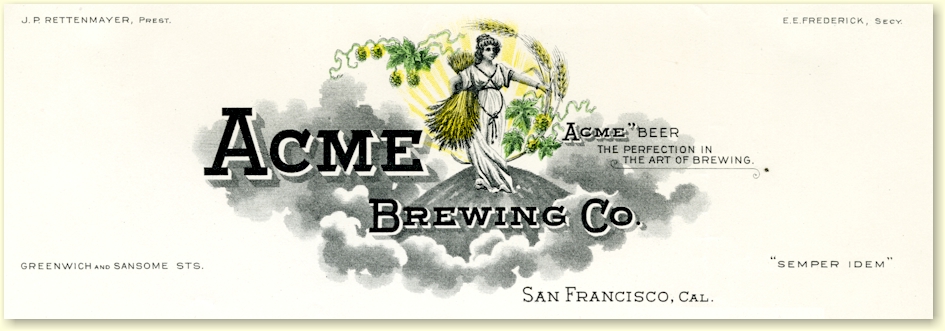
After a few years, the symbol for Acme Beer became the
female figure of Ceres, the goddess of agriculture. She can be seen on the 1911
letterhead
(top of page), in an early ad (right), on the label below, and on a
promotional graphic below the label.
She is also on an enamel sign (seen near bottom
of page - with other Acme Breweriana). The sign was
originally affixed to Heinhold's First & Last Chance Saloon located
across the Bay in Oakland in what is now known as Jack London
Square.
 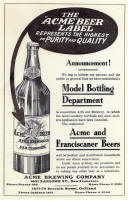 The ad
(at right) was published in July of
1911 and announced Acme's new bottling department. Click for
larger image. The ad
(at right) was published in July of
1911 and announced Acme's new bottling department. Click for
larger image.
The label shown
here is the same as in the ad
announcing the new bottling dept. As mentioned above, initially Acme
contracted the services of outside bottlers, as yet having no
bottling capabilities of their own.
A SF City Directory shows Acme
listing its bottling works at 162 Guererro. That was the address for
John Fauser's Phoenix Bottling Works. Fauser was Acme's sole agent,
and they bottled their line of beers until 15 May 1911, when the Olympia Beer Company's bottling line became part of the Acme Brewing
Co.
By this time, Acme's main brands were Acme Beer and Franciscaner,
as seen on the sign below.
They also produced a seasonal Bock beer.
|
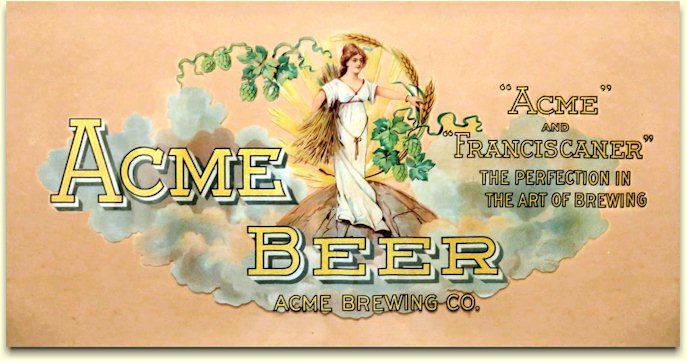
Acme issued numerous advertising pieces in the '30s & '40s, however
very few items have survived from the 13 year period prior to
Prohibition. This beautiful sign, ca.1910 (above) and the
curved enamel sign, both depicting the goddess Cereus, are notable
exceptions.
The famous "Acme stein-girl" beer label (below) was
introduced in 1914. This familiar image was used through Prohibition on Acme's low alcohol Light Beer,
and remained as the symbol of Acme upon Repeal in 1933.
A comparative look at the
Stein Girl
labels is offered in the this
article. |
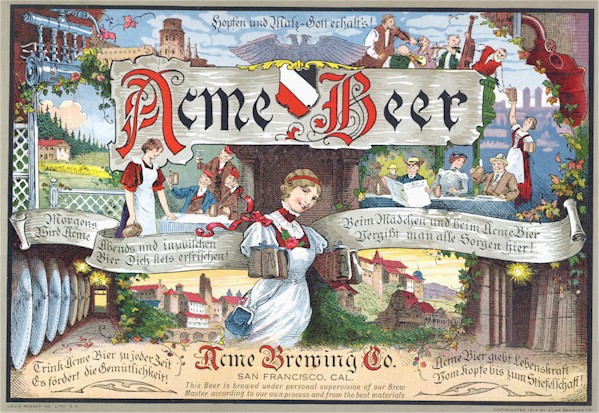
Original Acme label with German
text © 1914
|
The label (above) was unusual in that it had none of the
required legalize spelled out. Instead all of that required
information was printed on a label affixed to the back of the
bottle. I suppose they didn't want to compromise the artistic
integrity of their new design. An example of one of theses labeled
bottles
(below) shows a neck label which had "ACME" with the signature, "JP Rettenmayer" and "Brew Master," as well as "net contents 1 pt. 5
fluid oz." plus the rear label with the govt. required notations
(below right).
Strangely the bottle has the ceramic swing stopper on a bottle made
for the crimp-on crown cap. Perhaps the folks in S.F. liked the
ability to re-seal the bottle if they didn't finish their beer?
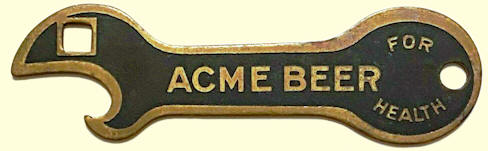
However, they did distribute their beer with the crown cap closure,
otherwise they wouldn't have provided these cap lifters.
|
_small.jpg)
bottle, ca.1914 |
_small.jpg)
neck label |
_small.jpg)
rear label |
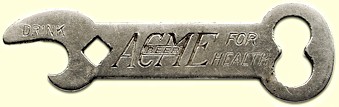
drink Acme Beer for health
When Washington and Oregon voted for statewide prohibition,
brewers were given one year to sell their stocks and shut down
operations by the 1 Jan. 1916 deadline. National prohibition was to
occur four years later, but many didn't think that would happen.
Consequently, Olympia's beer production was shifted to the Acme
plant in California. Olympia's Bellingham Bay Brewery was closed and
its equipment shipped to San Francisco. Its
Port Townsend Brewery was also
closed, but the Tumwater and Salem plants operated for a short time
by manufacturing fruit beverages and near-beer. |
|
On January 17, 1917, an association of six breweries was
incorporated, but the announcement wasn't made until two months later.
On March 12, 1917, the San Francisco Call-Bulletin
reported:
"Six San Francisco breweries, facing financial loss,
or insolvency, through proposed legislation regulating manufacture
of maltuous drinks, have pooled their interests into one association
for the manufacture and distribution of beers and malts. The body is
to be known as the Acme-National Brewing Company². J.P. Rettenmayer,
president of the Acme Brewing Company and head of the State Brewers'
Association, is president of the consolidated companies.
This announcement was made today by Charles O.
Swanberg, president of Merchants' Ice & Cold Storage Company,
and a heavy stockholder in two of the affected concerns.
The breweries included in the merger are: National
Brewing Company,
Henry Weinhard Brewery, Claus Wreden
Brewing Company, Union Brewing and Malting Company,
Acme Brewing Company and
Broadway Brewing
Company."
This was a co-operative venture to give the participants more
power in buying and selling. The Association was to have no paid-in
capital stock, and profits were to be distributed on the basis of
business prior to the consolidation. The members expectations were that
by buying and selling in bulk they could materially reduce expenses.
Only two of the breweries continued as operating plants of the (renamed)
California Brewing Association (CBA): the Acme Brewery, and the
National Brewery. All of the other breweries ceased production
and closed, but their parent companies continued as principals
in the Association .
In October, 1917, Anton Dolenz left the Oakland
Brewing & Malting Co. to assume the position of production
supervisor for the Calif. Brg. Assn. Dolenz had been a classmate
of J.P. Rettenmayer's at the Whal-Henius Institute of
Fermentology, which may have had something to do with the hiring, but
he brought considerable expertiese to the job. In August, 1919,
anticipating the cessation of brewing of full strength beer, he
filed a patent for a process of making a low alcohol content
beverage.
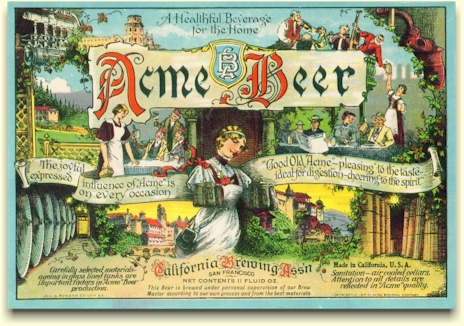 Also in 1917, the original 1914
stein-girl label (above) was updated to reflect the
new corporate structure, and to address social issues of the
time. Also in 1917, the original 1914
stein-girl label (above) was updated to reflect the
new corporate structure, and to address social issues of the
time.
With the war in Europe, a strong anti-German
sentiment was sweeping America. Consequently, Acme replaced the
double-eagle and tri-color, shield with an CBA monogram (Calif. Brg.
Assn.), and replaced all German text with English. Above the new monogram was: "A
Healthful Beverage for the Home," and the middle banner now
proclaimed: "The joyful temperance of Acme is expressed on every
occasion," and "Good Old Acme - pleasing to the taste - ideal for
digestion - cheering to the spirit." These slogans were
designed to appease the prohibitionists and attempt to distance
beer from the liquor industry, but it didn't help.
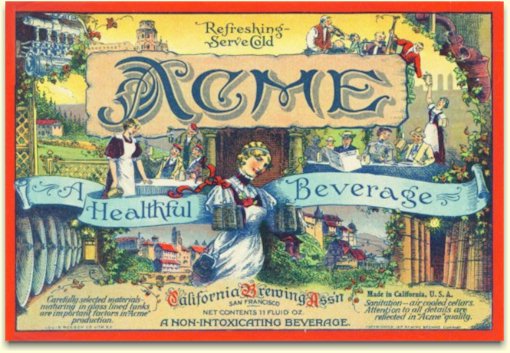 Caving
to the Prohibitionists, President Woodrow Wilson imposed a
partial prohibition in January of 1918. This purportedly would conserve grain for the war effort in Europe. The
alcohol content of beer was limited to 2.75% and output was
restricted to 70% of the brewery's previous year's production.
Then eight months later, in September of 1918, the president
issued an outright ban on the wartime production of beer.
Consequently, the CBA modified their 1917 label to reflect their
low alcohol brew by removing "Beer" and adding: "A Healthful
Beverage." Caving
to the Prohibitionists, President Woodrow Wilson imposed a
partial prohibition in January of 1918. This purportedly would conserve grain for the war effort in Europe. The
alcohol content of beer was limited to 2.75% and output was
restricted to 70% of the brewery's previous year's production.
Then eight months later, in September of 1918, the president
issued an outright ban on the wartime production of beer.
Consequently, the CBA modified their 1917 label to reflect their
low alcohol brew by removing "Beer" and adding: "A Healthful
Beverage."
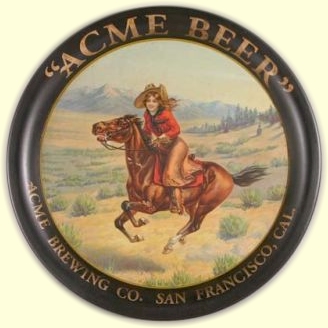 Prior to Prohibition Acme did not appear to produce many promotional
advertising pieces. Upon acquiring the National Brewery, Acme adopted
that brewery's use of western themes (see tray at right). This is
a full size "stock" tray, and I know of no other Acme beer trays. A San
Francisco collector has duplicate Vienna Art plates with Acme on the front
and advertising on the reverse, with one advertising "John Fauser, Acme
agent and bottler, Guerrero St." and the other has "Acme Brewing Co. 1401
Sansome St., San Francisco." There are also identical images on trade
cards from both Acme & National which depicts a Pony Express rider
appearing to burst through the card's surface. National used this same
graphic on an oval beer tray. Prior to Prohibition Acme did not appear to produce many promotional
advertising pieces. Upon acquiring the National Brewery, Acme adopted
that brewery's use of western themes (see tray at right). This is
a full size "stock" tray, and I know of no other Acme beer trays. A San
Francisco collector has duplicate Vienna Art plates with Acme on the front
and advertising on the reverse, with one advertising "John Fauser, Acme
agent and bottler, Guerrero St." and the other has "Acme Brewing Co. 1401
Sansome St., San Francisco." There are also identical images on trade
cards from both Acme & National which depicts a Pony Express rider
appearing to burst through the card's surface. National used this same
graphic on an oval beer tray.
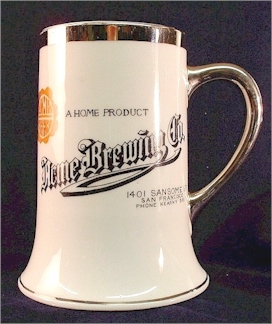 Marketing during this period
attempted to distance Acme from prohibition forces, and specifically the
Anti-Saloon League, by referring to their beer as a "A Healthful Beverage
for the Home"
(see mug at left). Another slogan was "Good Old Acme - pleasing to
the taste - ideal for indigestion - cheering to the spirit." Other brewers
attempted the same marketing strategy but failed in their efforts to
characterize beer as a healthful beverage, as opposed to an intoxicating
drink. On 16 Jan. 1920, the 18th Amendment became law, and beer was
prohibited along with all of the other alcoholic beverages. Marketing during this period
attempted to distance Acme from prohibition forces, and specifically the
Anti-Saloon League, by referring to their beer as a "A Healthful Beverage
for the Home"
(see mug at left). Another slogan was "Good Old Acme - pleasing to
the taste - ideal for indigestion - cheering to the spirit." Other brewers
attempted the same marketing strategy but failed in their efforts to
characterize beer as a healthful beverage, as opposed to an intoxicating
drink. On 16 Jan. 1920, the 18th Amendment became law, and beer was
prohibited along with all of the other alcoholic beverages.
Footnote:
¹ On 29 Nov. 1917, Leopold
Schmidt's only daughter, Philippine, and John Paul Rettenmayer
were married.

|
Prohibition
(1920-1933)
Cereal Products Refining Corp. and
California Bottling Assn.
On 8 January, 1920, just
eight days prior to Prohibition was to take effect, the California Brewing
Association (CBA) reorganized as the Cereal Products Refining Corporation (CPRC), with J.P.
Rettenmayer, president. The name change was necessary as the word "brewing" was
no longer allowed. However, CPRC would later adopt California
Bottling Association as the name of the Acme plant,
thus retaining the CBA trade mark.
The CPRC members were the Acme
Brewing Co., National Brewing Co., Union Brewing & Malting,
Claus Wreden Brewing Co., and Broadway Brewing Co. However, the
corporation retained only two operational units - National and
Acme. The other three had shuttered when the California Brewing
Assn. was formed in 1917.
Through all of Prohibition the National
Plant, at 741-762 Fulton St., was doing business under the corporate name, Cereal Products Refining Corp. They produced
Cereal Malt Syrup, Oro Syrup, Alta Syrup, Cerex Syrup, Peerless Yeast, and
Peerless Vinegar. They also manufactured Fairy Ice Cream.
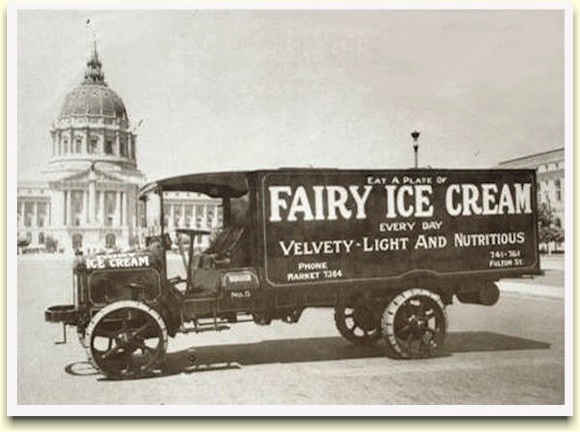
truck in front of SF City Hall, ca.1922
In
September of 1921, the Acme Brewing Co's. plant, on Sansome Street,
began doing business as the California Bottling Assn., a division of the
CPRC, and
capitalized at $100,000. It was organized by J.P. Rettenmayer, S.H.
Herold, and Chas. F. Hansen. Their brewmaster was Anton Dolenz, who joined
the company in Oct. 1917.
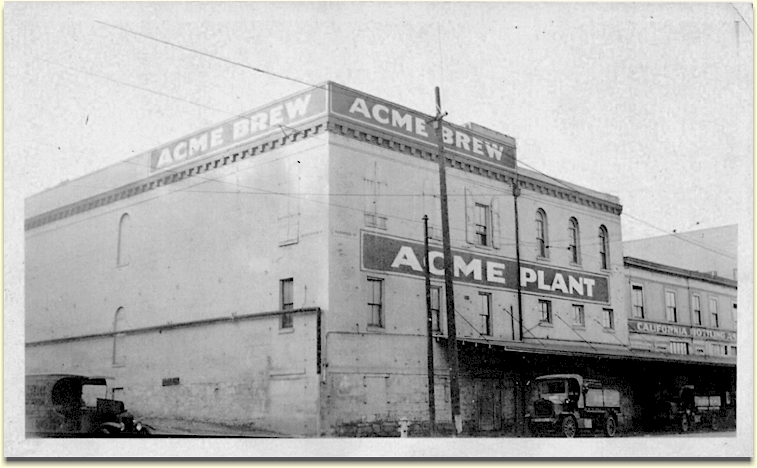
Calif. Bottling's Acme Plant
Dolenz formulated
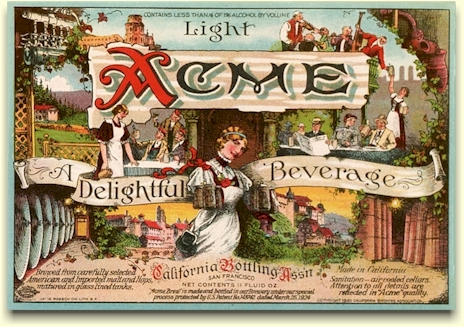
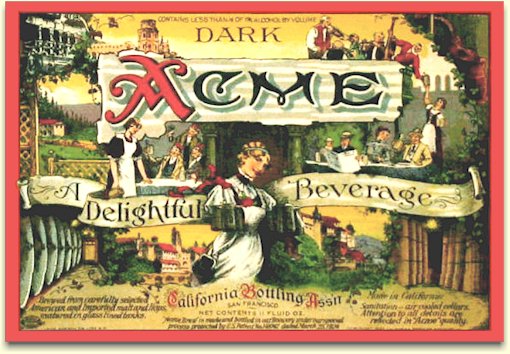
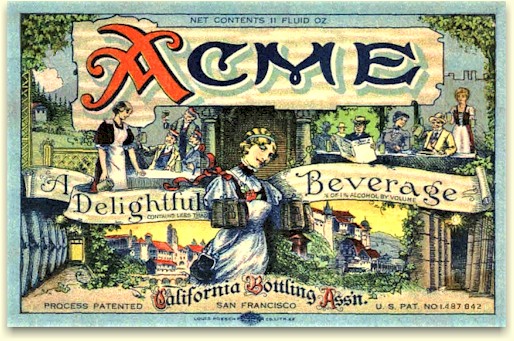
a low-alcohol cereal beverage, or near-beer, they called Acme Light. The 1918 version
(above) of the
stein-girl label was used, but the word "Beer" had to be removed. They also changed the
Acme font. The
result was the origin of the iconic, red "A" that remains in use today.
Acme "Light" Beverage was soon followed by a "Dark" version.
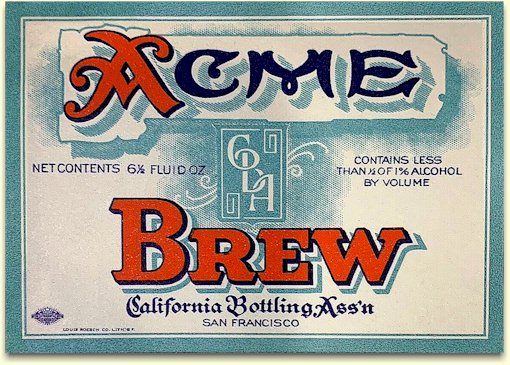
On March 25, 1924, the brewery patented their brewing
process for Acme Brew (the registered name for their near-beer) and the
patent date appears, center bottom, on the label. They also
simplified the graphics by removing the brewing equipment from the
corners, removing the castle and the band from the top of the marquee.
This version was essentially the label used when beer beer became legal
nine years later.
It appears that the Fulton plant didn't producing near-beer, since no Prohibition labels have appeared under the Cereal
Products Refining Corp. banner. The Fulton Street plant was apparently
dedicated to malt, syrup, yeast, vinegar and ice cream production.
Ice cream was also being made in the Sansome St. plant.
Acme-Maid was a product of the Acme Ice Cream Co., who's
office was down the street at 1313 Sansome. In about 1924,
the Fairy Ice Cream Co. merged with Acme.
But the Calif. Bottling Assn. plant on Sansome St. was producing more than ice
cream.
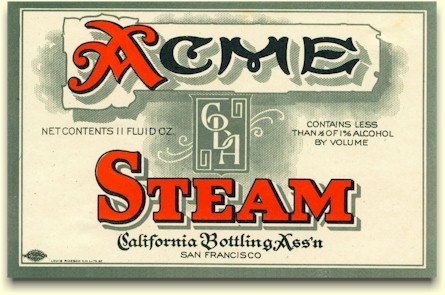
 They
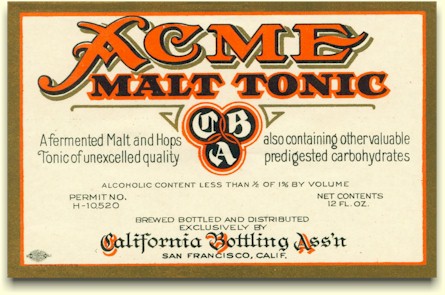
also produced Acme Beverage (above), as well as Acme Brew, Acme
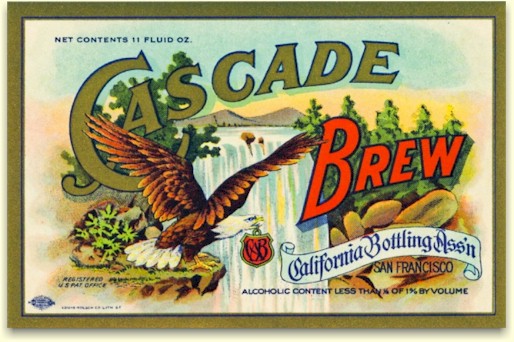
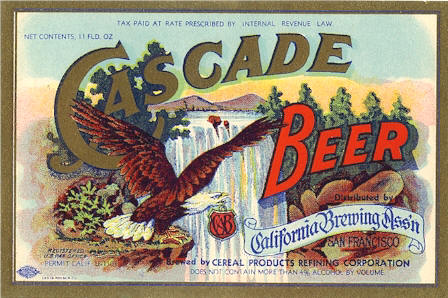
Steam, and Acme Malt Tonic. They also made a Cascade Brew. For this
label they used the eagle label from the Union Brewing & Malting Co. that had
been part of the 1917 merger (thumbnail at right).
The plant also did contract brewing for at least one other company. As
late as Nov. 1928, the Calif. Bottling Assn. brewed & bottled NC Export
Brand Brew for the N. Cervelli Bottling Co. of SF.
Low alcohol beers were only popular in that they could be spiked with
grain alcohol to make them closer to the real thing. But soft drinks
were also a money maker. They proved popular as mixers for illicit liquor
- though they weren't advertised as such.
 The Sansome St. plant produced a sparkling Lime Rickey and a sparkling
Orange, as well as a Grapefruit, and a Ginger Ale - all of which were
popular mixers for boot-leg gin. For these labels they chose a different font for
the "Acme" brand name, (thumbnail right) to differentiate them from the near-beer products.
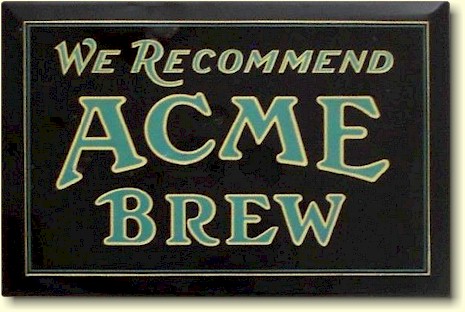 Tin-over-cardboard sign, ca.1925
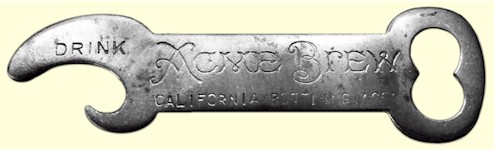 Acme Brew cap lifter, ca.1925
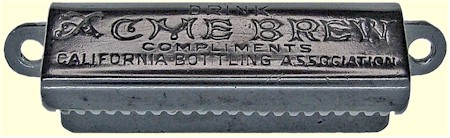
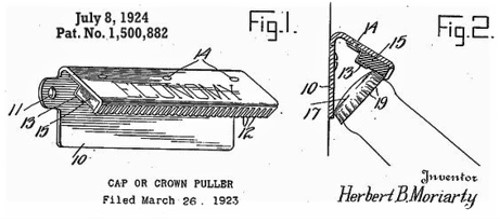
Acme Brew wall mounted crown cap puller, ca.1924
In 1929, the Merchants Ice & Cold Storage Co., purchased
20% of the Acme Brewing Co., a.k.a. the Cereal
Products Refining Corp., and obtained control of
the Sansome Street plant. In
May of '33 - a month after Repeal - the Sansome
plant was leased to a group who re-opened it as the
Globe Brewing Company. Globe operated it
for a mere five years, closing in 1938.
|
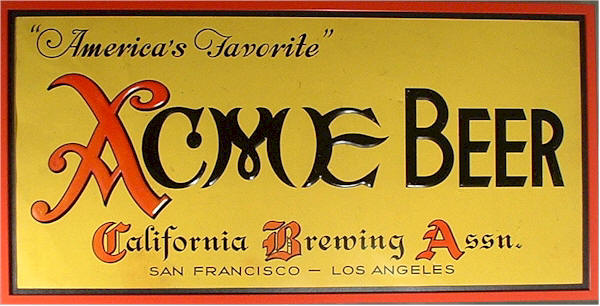
|
Repeal - 1933
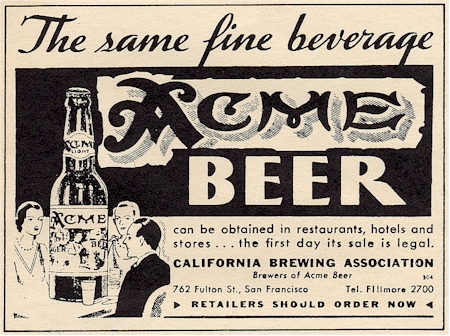 As
previously discussed, the Acme Brewing Co. and the National
Brewing Co. had joined the California Brewing Association in
1917, but the CBA had to change their name in 1920. Then in 1932,
with Repeal eminent, the corporation was able to resume
operating as the California
Brewing Ass'n. As
previously discussed, the Acme Brewing Co. and the National
Brewing Co. had joined the California Brewing Association in
1917, but the CBA had to change their name in 1920. Then in 1932,
with Repeal eminent, the corporation was able to resume
operating as the California
Brewing Ass'n.
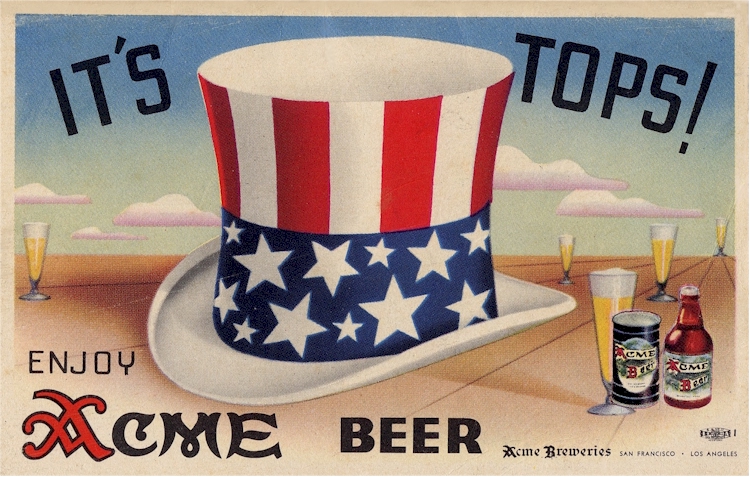
Acme's management chose to be proactive in promoting beer
sales and were the first brewery to start newspaper
advertising of beer, even before Repeal became an actual fact.
The ad shown at right is one of the ads that set the whole west
coast talking about Acme, weeks before Prohibition was ended, on
April 7, 1933.
They ultimately became the most prolific and consistent brewery
advertiser in newspapers. They then expanded their media blitz
through numerous radio spots and innovative billboard
advertising. These aggressive and on-going campaigns made
Acme the most famous, and popular brand of beer in the West.
One short-lived campaign in 1947 boasted, "Fine Beer Since 1860". The assumption made by many was that Acme had been
around since then, but the ads didn't actually say that, just
implied as much. This 1860 reference acknowledges the family
tradition of brewing brought to Acme Breweries by its executive management. This heritage rests primarily on two brewing
families: Adams and
Schuster.
Acme invested heavily in advertising and used ad agencies to
come up with their ever-changing campaigns. For a
few of the more long-lived campaigns and their approximate years
of use go to my illustrated guide to the many
Acme campaigns. |
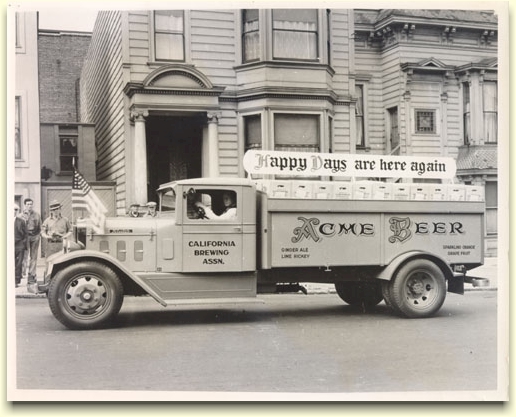
Acme delivery truck after Repeal in 1933
|
 |
 |
|
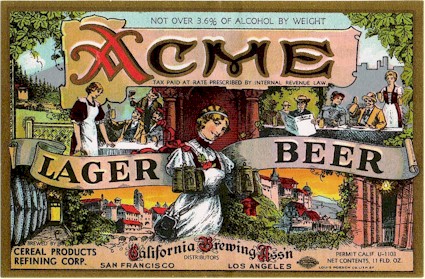
From 1933 to 1936 the Fulton & Webster St. plant continued to operate as the
Cereal Products Refining Corporation. They modified the Prohibition label
from 1924 for their flagship brand, Acme.
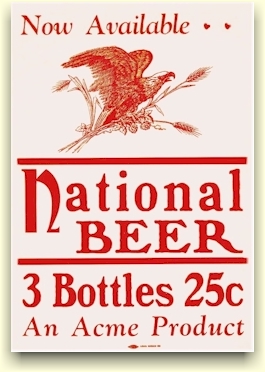
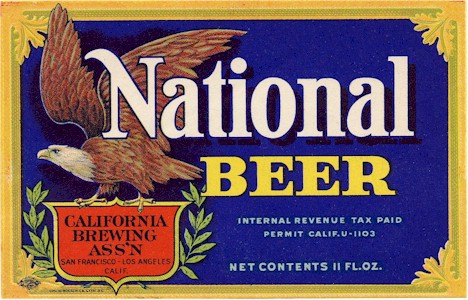
The National label (above- right) is a 1933 version of the
pre-Prohibition label from the National Brewing Company, which
joined the California Brewing Association in 1917. Upon Repeal the
Ass'n. re-introduced this familiar San Francisco brand to help
recapture as much of the newly opened market as possible. The beer
was selling three for a quarter. The Ass'n. relegated
the National label to a buget, secondary brand and focused all their marketing efforts in
the promotion of their flagship brand - Acme Beer.
Their first sales of Acme Lager was offered in 11 ounce bottles,
but in July '33 they re-introduced the 1 pt. 6 fl. oz. bottle, i.e., 22
ounce
bottle. The 22 oz. was a popular size used prior to Prohibition.
A popular practice, prior to Prohibition, was taking draft beer home
from the tavern in a "growler." Acme accomodated this practice by
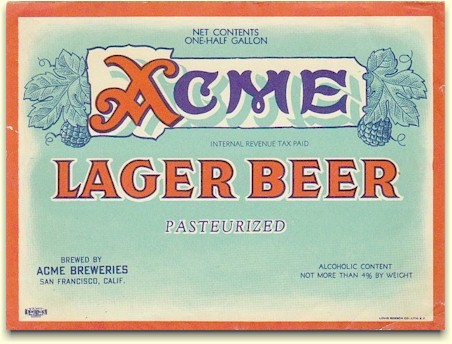
offering half gallon jugs of unpasteurized beer that had a label with
the warning: "This beer is UNPASTEURIZED and must be kept
under refrigeration. KEEP COLD." Since less than 25%
of housholds had refrigerators, and ice boxes weren't high capacity,
it's clear that most didn't follow the label's instructions and the
beer spoiled. Consequently, Acme discontinued their unpasteurized
beer and began offering a pasteurized product instead. Handling
instructions were no longer needed!
Like Acme, the Globe
Brewing Co. experienced the same problems with the mishandling
of their unpasteurized Draft Beer, but were so invested in the
process that they had to file for bankruptcy protection to
restructure.
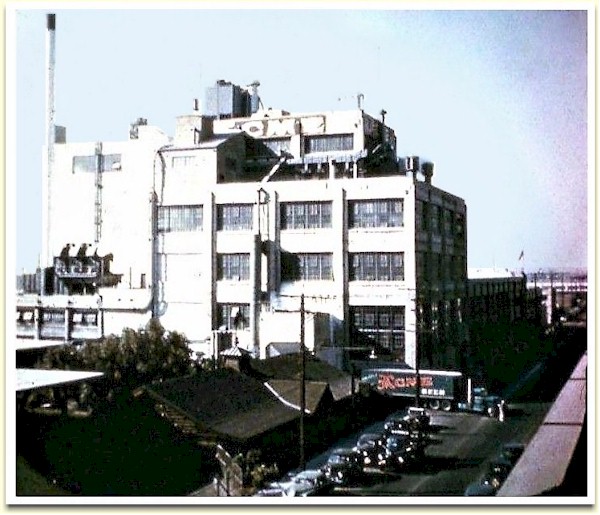
Acme Plant, Vernon, CA, c.1935
 In partnership with its Southern California agent, Bohemian
Distributing Co., Acme built a plant in Los Angeles (Vernon) at 2080 East 49th
St. The brewery was positioned between Bohmeian's headquarters and the
Sequoia Lodge, which was the hospitality center for two operations.
The plant operated as the Acme Brewing Co.
from its opening in June of 1935. In partnership with its Southern California agent, Bohemian
Distributing Co., Acme built a plant in Los Angeles (Vernon) at 2080 East 49th
St. The brewery was positioned between Bohmeian's headquarters and the
Sequoia Lodge, which was the hospitality center for two operations.
The plant operated as the Acme Brewing Co.
from its opening in June of 1935.
On April 1, 1936, the San Francisco brewery began operating as Acme
Breweries, to reflect the addition of a branch brewery in Los Angeles, and their labels reflected the name change. However, Acme's
corporate name remained the
California Brewing Association.
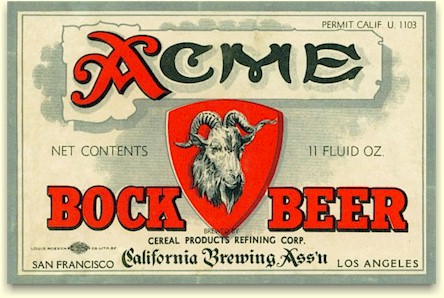
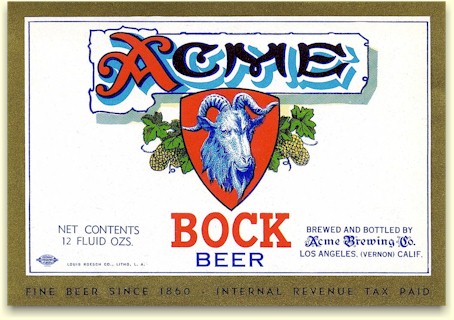
Like most U.S. breweries, Acme produced a seasonal Bock beer. It was
brewed in the winter and was traditionally released the following March. Acme's
first Bock beer was available on 17 March, 1934. The label was
similar to that of Acme Steam, and Acme Brew from the Prohibition
era.
The 1934 label was also used for the 1935, and '36
release. For 1937 the label was changed to the white version shown
above. This label remained in use until 1950, with the exception of 1943
through 1947 when there was no Acme Bock produced due to wartime and
postwar shortages of malt and oth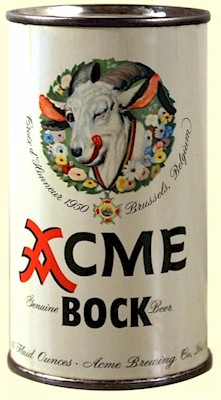 er grains. er grains.
In January, 1936, Acme introduced canned beer and ale, but oddly
they didn't can their Bock Beer until 1950. They then used the
design of the white label above, but for only the March 1950
release. That same year they won an award at an Exposition in
Brussels and to tout this international recognition they redesigned
the can (right) and bottle labels for the 1951 Bock season. The Cascade label (below) is a 1933 version from Acme's SF
plant, which was doing business as the Cereal Products Refining Corporation from
the onset of Prohibition in 1920, until 1936. This label used the
same graphics that was used for Cascade Brew during Prohibition. Like the National
brand (above) Cascade enjoyed a limited release to appeal to the
pre-Prohibition patrons who may have had some brand loyalty.
However, the decision was made to go with the Acme brand
exclusively, and Cascade, as well as National, was dropped. |
|
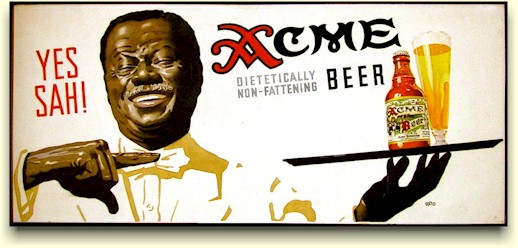
 Upon start-up in 1933 Acme adopted a brilliant marketing concept
directed at an untapped market - women. It advertised its beer as
"Dietetically Non-Fattening" and following the asterisks the fine
print says: "Relatively so, compared with other foods." Upon start-up in 1933 Acme adopted a brilliant marketing concept
directed at an untapped market - women. It advertised its beer as
"Dietetically Non-Fattening" and following the asterisks the fine
print says: "Relatively so, compared with other foods."
This caused the Federal Trade Commission, who was devoted to
fair practices in advertising, to move against Acme Breweries.
However, it took until 1951 for the Commission's decision that the
words, "Acme beer contains no fattening substances and will not
increase consumer's weight," was still considered a deceptive
nutritional claim. So, Acme dropped the advertising campaign, but by
then they had doubled their capacity and captured nearly 50% of the
California beer market.

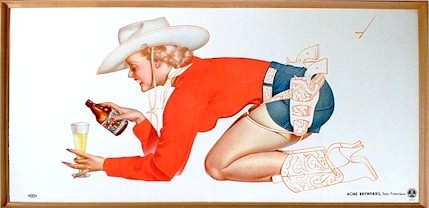
In 1939 Acme commissioned George Petty (who had just left
Esquire magazine) to paint three lithesome gals which were
used for the 1940, '41, and '43 campaigns. These
images were utilized in a number of different formats. They produced a
26" and a 33" wide, framed image for wall hanging;
a 12" wide, framed version on an easel for back-bar display; and a
cutout window card that was 42" long and easel mounted for window
displays.
The Petty cowgirl, ca.1943 (below), was a very popular image
- given Acme's fondness for western themes. The cowgirl image was
also used on an aluminum serving tray (below) and for this
back-bar chalk figurine
(right).
|
|
 |
 |
|
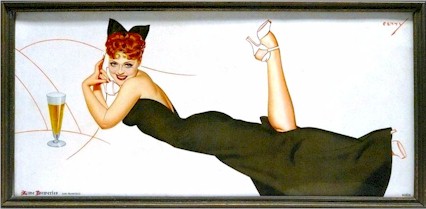
Acme commissioned a number of well known graphic artists for their
advertising campaigns. In 1940 alone they used George Petty, C.
Maurice Mayer, Joseph Biner, and Frederick Mizen. Acme also used the
artist, Alberto Vargas for some of their promotional material
(example below).
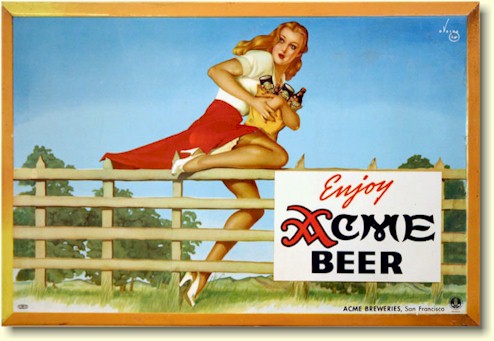
However, there' one artist that Acme used that I've been unable to
learn anything about. All I know is his sur-name, Reid. It's clearly
shown on his illustration (below) which would have been painted
between 1937 and 1940. If anyone has information on this artist
please contact me.
original artwork by Reid, 33" x
16"
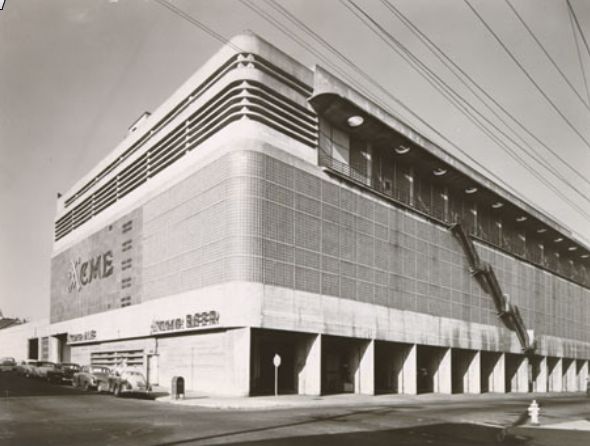
In 1941 Acme Breweries
built a $750,000 ($13.7 million in 2020) bottling plant
adjacent to the old National Brewery site at Fulton & Webster in San
Francisco. The five-story structure was constructed of glass,
concrete, and feno-porcelain steel. The Insulux glass blocks were
developed for Acme by Owens-Illinois, with clear glass on the
outside, and amber on the inside. The plant was described by
architects and designers as "one of the worlds most beautiful
industrial buildings." It was demolished in 1968, but they retained
the ground floor upon which was built three stories of condominiums.
|
|
The War Years
 With
the outbreak of WWII citizens and business were called upon to
conserve materials needed for the war effort. Consequently there was
a shortage of materials required for the brewing and packaging beer,
and canned beer was available only for the armed forces. With
the outbreak of WWII citizens and business were called upon to
conserve materials needed for the war effort. Consequently there was
a shortage of materials required for the brewing and packaging beer,
and canned beer was available only for the armed forces.
Even
bottle caps were hard to come by. So Acme began
promoting its quarter gallon, "Victory" size bottle which would use
one cap instead of three - "Victory Size for the Economy-Wise." The
Lever type Kork-N-Seal closure (right), was especially
handy for resealing the larger quarter gallon
bottles.
Patriotism was also a popular promotion theme. Acme
actively encouraged numerous means to aid the war effort. They
advocated giving blood; planting Victory gardens; writing to the
troops; recycling cooking grease to your butcher; and other
economizing activities. At the close of each ad came the caption:
"Acme...the beer with the high I.Q. (It Quenches). Buy Another
Bond."
|
|
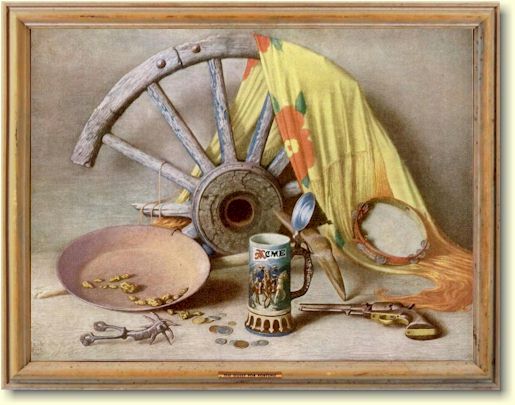 At the end of the war, Acme
resumed its heavy advertising and in 1945 commissioned
Claude Buck (1890-1974) to paint an original picture that
alluded to Acme's long tradition of brewing, and to its
native California origins, attempting to promote allegiance
to a local brand over the nationals.
For details on the painting go to: Quest. At the end of the war, Acme
resumed its heavy advertising and in 1945 commissioned
Claude Buck (1890-1974) to paint an original picture that
alluded to Acme's long tradition of brewing, and to its
native California origins, attempting to promote allegiance
to a local brand over the nationals.
For details on the painting go to: Quest.
The painting was titled "The Quest for Fortune" and
was distributed heavily to taverns and grocers. The painting
was printed on cardboard, framed without glass, and often had a
brass title name plate affixed to the frame. Since this
piece appeared to be more a work of art than a beer ad, many
survived. However, those that were displayed in taverns tend
to be darkened from cigarette smoke since there was no glass
to protect the surface.
 Sales
were slipping in the late '40s and the company updated its
packaging, and continued with their heavy advertising, but
they were having difficulty living down their reputation for
making bad beer during the war. Their brewmaster, since
1917, was Anton Dolenz. In an attempt to compensate
for the shortage of rationed brewing ingredients he tried
Manioca meal (also called Cassava), as
a cost saving adjunct. Consumed at the proper
temperature the beer must have tasted alright, but the
troops in the Pacific lacked the capability to
properly chill the beer. This resulted in what they
described as a "skunky" brew. "I'll have a beer,
anything but Acme," was often heard in taverns after
the War. Sales
were slipping in the late '40s and the company updated its
packaging, and continued with their heavy advertising, but
they were having difficulty living down their reputation for
making bad beer during the war. Their brewmaster, since
1917, was Anton Dolenz. In an attempt to compensate
for the shortage of rationed brewing ingredients he tried
Manioca meal (also called Cassava), as
a cost saving adjunct. Consumed at the proper
temperature the beer must have tasted alright, but the
troops in the Pacific lacked the capability to
properly chill the beer. This resulted in what they
described as a "skunky" brew. "I'll have a beer,
anything but Acme," was often heard in taverns after
the War.
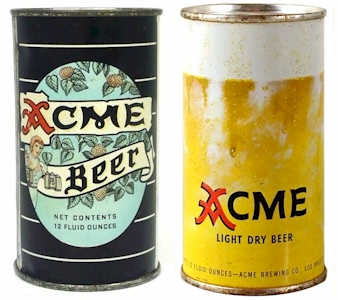
On 27 Dec. of 1950, Acme announced that assistant
brewmaster, George Goerl had replaced Anton Dolenz, who was
retiring after 35 years with the company. As well as
production supervisor, Goerl was also now superintendent of
chemistry, and by May of '50 he had formulated and test
marketed a new "Light, Dry Acme Beer" in
 cans that looked
like a glass of beer (above). cans that looked
like a glass of beer (above).
For this new
can the company made the questionable choice to drop their
iconic, red "A" in favor of a bland, simplified font.
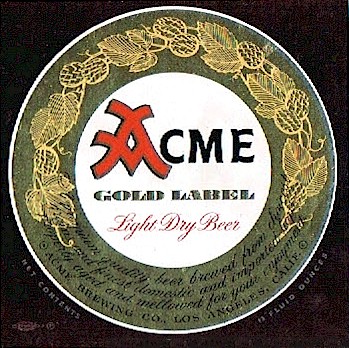
Then in
October of '50 they altered the can by
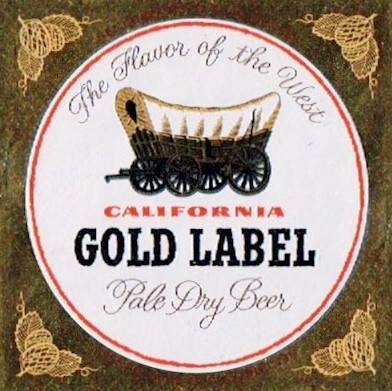
placing "Gold Label" below "Acme" and changing the "Light Dry Beer"
notation from black, block letters to red script
At the same time they also dropped the stein girl labels on
bottles, and switched to the new Gold Label version
(right).
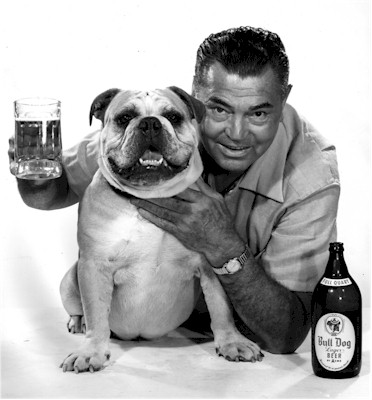
In December of 1951 they
made a major
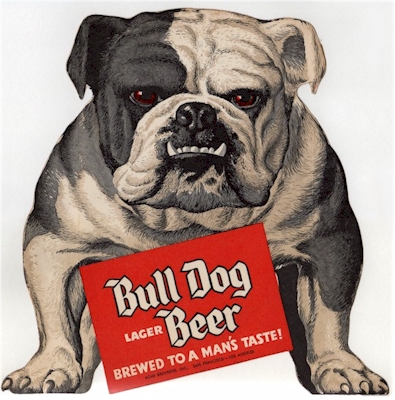
marketing decesion by adding "Bull Dog
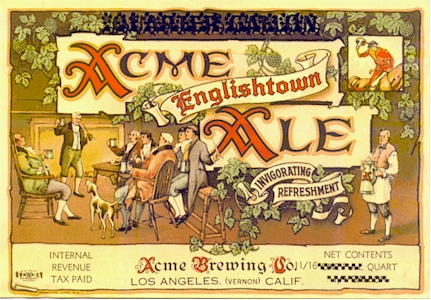
Ale" to their line-up, reviving the 1941 slogan used for their
Englishtown Ale -"A Pip of a Nip in Every Sip".
Strangely, they hyped it as "a he-man's beverage" totaly
dismissing their female clientale. Then six
months later, in June of '52, they specifically targeted the male consumer
with the introduction of Bull Dog Lager Beer.
The slogan was: "Brewed to a Man's Taste!"
The Bull Dog brands
did surprisingly well and gave the company some needed
revitalization. To maximize their success, in Feb. '53, they
enhanced their line-up with a Bull Dog Stout Malt
liquor.
In March of 1953 they hired the
quintessential "alpha male"
to promote the brand -
previous world heavyweight champion, Jack Dempsey. This was
quite a departure for Acme since they had been successfully
wooing the female demographic since 1933. They must have
felt that the females would be drawn to the classier looking
Gold Label brand, than the Bull Dog brands.
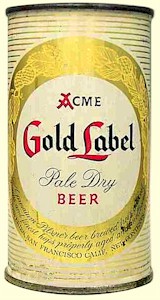 In 1952, they
updated the Gold Label can, that looked like a
glass of beer, and came up with the gold wreath look of the
can shown at right with "Acme" in smaller letters.
Bottle labels were also treated with this diminished
"Acme" label. But none of these changes mattered very
much, as
both the Gold Label and the Bull Dog brands were too
little - too late. In 1952, they
updated the Gold Label can, that looked like a
glass of beer, and came up with the gold wreath look of the
can shown at right with "Acme" in smaller letters.
Bottle labels were also treated with this diminished
"Acme" label. But none of these changes mattered very
much, as
both the Gold Label and the Bull Dog brands were too
little - too late.
The national breweries were
on the move, and regional breweries were losing market
share. Many struggling breweries couldn't compete during
the price wars of the mid-fifties and were bought out by
the nationals or closed.
In January of 1954, both the LA & SF plants
were sold to the Liebmann Breweries of NY, who was making
an attempt to go national. Liebmann operated the LA
plant for three years as the Rheingold Brewing Co.
Then in 1957 they then sold it to the Theo. Hamm Brewing Co.
who had a 15 year run, closing the plant in 1972.
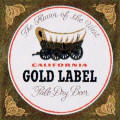 The SF plant was operated as the California
Brewing Co. from '54 to '58, and adopted a Conestoga style,
covered wagon as their logo. While they now owned the Acme
brand they chose to drop it from their product line.
However, they did continue producing the Gold Label and Bull Dog
brands. In 1958, Liebmann
gave up its national bid and closed the plant for good. The
plant, with an annual capacity of 700,000 barrels, was
dismanteled in August of '62. The SF plant was operated as the California
Brewing Co. from '54 to '58, and adopted a Conestoga style,
covered wagon as their logo. While they now owned the Acme
brand they chose to drop it from their product line.
However, they did continue producing the Gold Label and Bull Dog
brands. In 1958, Liebmann
gave up its national bid and closed the plant for good. The
plant, with an annual capacity of 700,000 barrels, was
dismanteled in August of '62.
When Liebmann Breweries closed the
California Brewing Co., Acme's LA agents and business
partners, the Bohemian Distributing Company, purchased the
rights to the Acme and Bull Dog brands, and from 1958 to
1968 Acme & Bull Dog was being produced for Bohemian by the
Grace Bros. Brewing Company of Santa Rosa, CA.
Then seven
years later, in 1975 the Acme brand, with its 1917 "Stein
Girl" graphics, was resurrected as a contract beer. It was
first produced by the General Brewing Co. of San Francisco,
and then the following year Blitz-Weinhard of Portland took
over the contract. By 1979 the brand was gone only to be
resurrected again in 1987 with the establishment of the
Xcelsior Brewery of Santa Rosa, CA. However, in a matter of
only two years Xcelsior folded and Acme was gone - but not
forgotten.
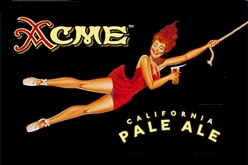
In 1996
the
North
Coast Brewing Company of Fort Bragg, CA obtained the rights
to the Acme brand, and it is still being produced. The use of
the iconic, 1917 font for their Acme logo reflects their
regard for the brand's history.
|
ACME BREWERIANA
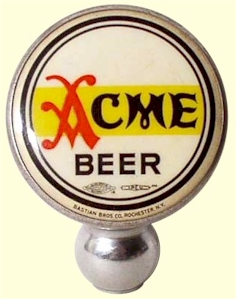
chrome, ball tap knob
|
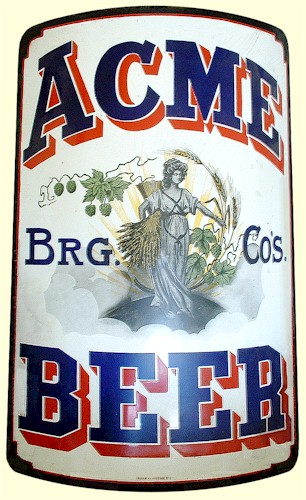
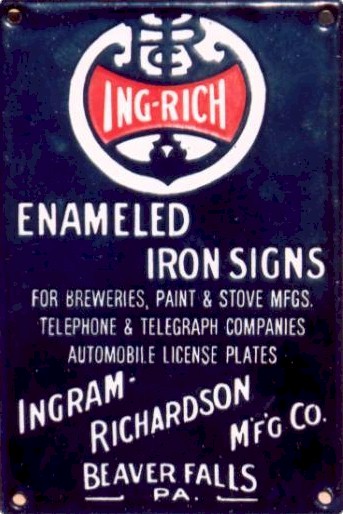
porcelain sign, ca.1907-'13,
Ingram-Richardson, Bever Falls, PA |
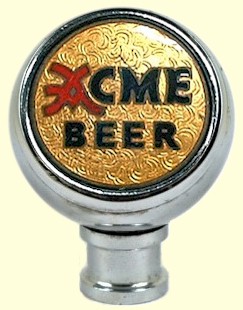
chrome, ball tap knob
|
|
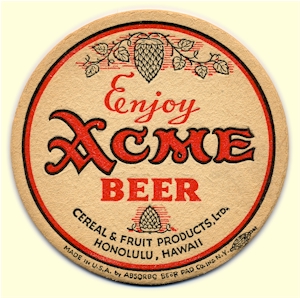
Acme's Hawaiian distributor,
ca. 1935 |
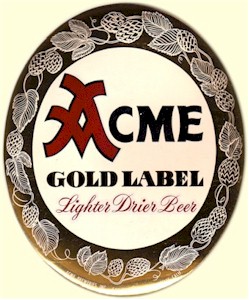
Heavy gold foil window
display, ca.1950
|
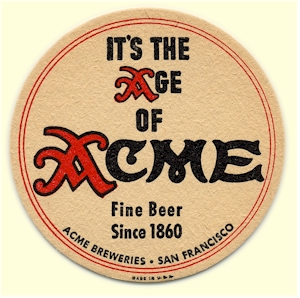
Acme beer coaster,
Ca. 1947
|
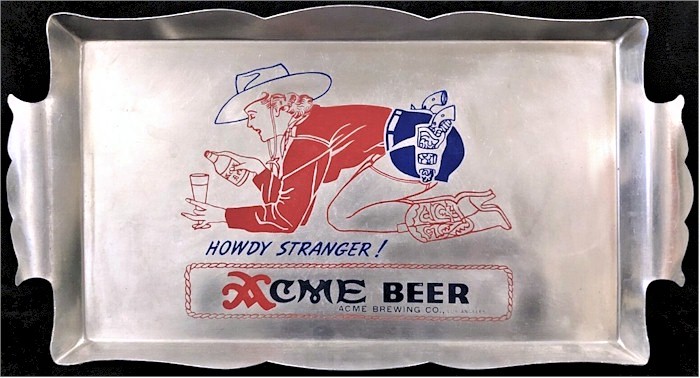
aluminum beer tray
by Petty ca.1943
|
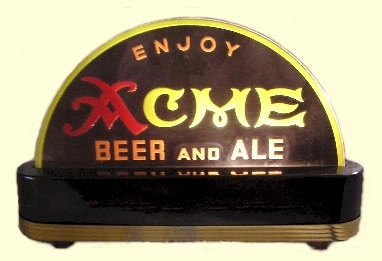
Back- bar
"Halo light", ca.1940,
by Price Brothers |
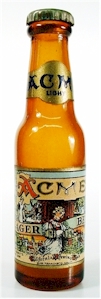
Miniature Salt,
ca.1935 |
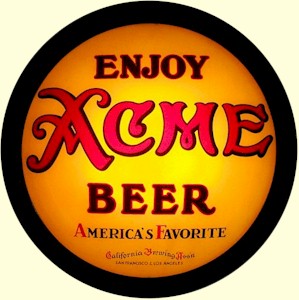
R.O.G. lighted
lens, ca.1933 |
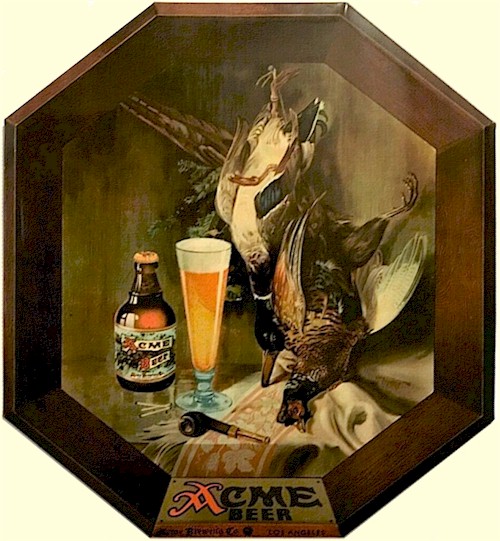
Acme T.O C. octagon sign c.1938
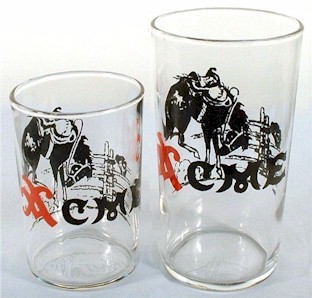
glasses, ca.1938
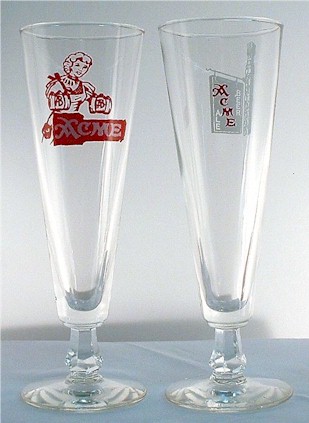
two scarce Acme glasses
NOTE - For a guide to dating Acme Breweriana - go to:
Acme Collectibles

|
Other Acme Breweries
While in no way related to the California Acme, the name has
been used by three other brewing companies. Prior to prohibition
there was an Acme Brewing Company in Macon, GA [1893-1916], and
one in Bentleyville, PA [1907-20]. Then after prohibition there
was an Acme Brewing Co. in Joliet, IL [1933-39], and Bentleyville
had a short run from 1933-34.
Acme Brewery Today
In
late 1935, the California Brewing Assn. built a three story, art
deco style building (shown here) to house their general offices
and sales department for the San Francisco plant. They also
moved their Hospitality/Tasting room to this new building.
The architect was William Gladstone Merchant.
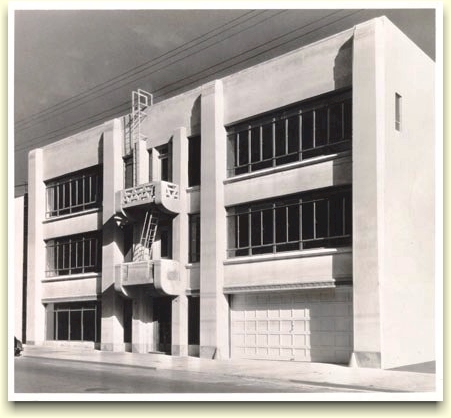
Acme's
Corporate Office, 762 Fulton St., S.F., ca.1935
Currently the building houses the African
American Art and Culture Complex, where the murals adorning the
interior walls of old Tasting room remain to this day. It is a
triptych (multi-panel) mural, depicting the cultivation of hops
and the production of beer. The mural was painted in 1935 by
Jose Moya del Pino, whose work also appears in Coit Tower on
Telegraph Hill.
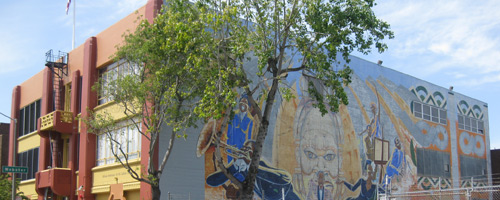
762
Fulton St. as it appears today.
The mural was painted in
1984 by Dewey Crumpler.
Article by
Gary Flynn
Acme Collectibles For Sale
|
|
|
|
|
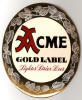 |
This display
item, a coaster, a can, a cap lifter, and two
different miniature beer bottles - go to:
MISC. |
|
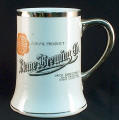 |
Acme Beer stein - go to: MUGS |
|
|
|
|
|
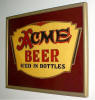 |
Acme Art Deco decal - go to
SIGNS |
|
|
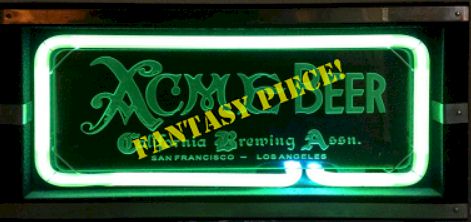
WARNING - Scamers are everywhere and they take images of
authentic Breweriana and produce fantasy pieces that unsuspecting collectors
purchase believing them to be genuine. Here's an example where a buyer sadly
paid $1,446 for a fake.
|
ACKNOWLEDGEMENTS
-
Thanks to Carol Donnett-Hertle, a Schuster family member who
supplied not only family history, but also great Acme history as
well.
-
A special thanks to Dr. Thomas Jacobs, noted San Francisco brewery
historian and collector, who provided the names and dates of
pre-prohibition personnel at Acme, as well as the opportunity to
photograph the early label and pre-pro, porcelain sign.
-
To Pat Franco for the 1910 Acme Beer sign, and the 1925 Acme Brew
sign.
-
To Rod Countryman for the original art work of the black
waiter with the tray of Acme beer.
-
To Karen at the Olympia Archives for the 1907 photo of the
brewery.
-
To Phil Foto for the 1935 photo of the Vernon Plant.
-
To the Wisherop family for the 1925 photo of the Acme plant
on Sansome St.
-
And to Harold J. Eblen for introducing me to the wall mounted
cap puller ca.1924 - for Acme Brew.
|
For any comments, additions, or corrections - or if you
have any Acme items for sale
(especially pin-up art by Vargas & Petty, or the "halo light" by Price
Bros.) - please
contact me:

All contents including images are copyright by BreweryGems.com
and can not
be used without permission from Brewery Gems.
Copyright
©
2004 ~ All Rights Reserved.

BREWERIANA
|
BREWERY HISTORIES |
SITE MAP |
CONTACT
|
| | | |


.jpg)
.jpg)
.jpg)