Olympia Brewing Co. - header image

History of the Olympia Brewing Company
(1902-2003)

founded as

The Capital Brewing Company
(1896-1902)
 

While this famous Tumwater, Washington company owned other breweries prior to Prohibition, it gained prominence with a single brand produced in a single plant. The excellence of its beer has been attributed to the excellent quality of the water - hence their slogan "It's the Water" - but full credit should be given to Olympia's founder, Leopold F. Schmidt who's business model was "Quality First - Quantity Next." See Biography of Leopold Schmidt.

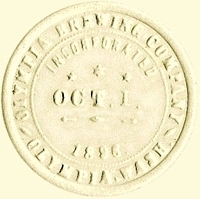
Olympia Brg. Co. corporate seal - image


The Early Years

As a member of Montana's State Capitol Commission, Leopold was part of a fact finding mission to western state capitals in the Summer of 1895. As the owner of the largest and most successful brewery in the state, after 20 years, Leopold wished to again be near the sea. Consequently, he was considering a new enterprise on the Pacific coast, and took this opportunity to access costal locations. On their visit to Salem, he toured the 3,500 barrel Capital Brewery (which he would purchase 8 years later). But a new capital building was under construction at Olympia, and while there he learned of some artesian springs at nearby Tumwater. His brother Louis had accompanied on the trip and the two toured the site to assess its suitability for a new brewery. His brewmaster experience told him that the water was of exceptional quality, and navigable access to the sound was all but assured, making this an ideal location.

On September 18, 1895, The Daily Olympian ran this story:

"LEOPOLD SCHMIDT ANNOUNCES PLANS TO BUILD BREWERY -
A deal which has been pending for several days culminated yesterday afternoon in the sale of five and one-quarter acres of land near the lower falls at Tumwater to parties from Montana, who will build a brewery on the property. The purchasers are L. F. Schmidt of Deer Lodge, Montana, and his brother Louis of Butte, These gentlemen have been around the past three days with Alex Drysdale, who negotiated the sale, and after making surveys of the property, estimates of the water power, etc., a satisfactory settlement was arrived at, the sum of $4550 in cash paid to Mrs. Fannie E. Biles, the owner of the property, a deed made out to Schmidt Bros. and placed on record yesterday afternoon.

The land comprises the plat between the Des Chutes and the Union Pacific grade and fronting on the sound. The Tumwater Ice company's plant is upon it.

It is the intention of Schmidt Bros. to put a brewery and ice plant costing $60,000 on the spot where the tannery now stands or near it, and to make other improvements. They will fill in a portion of the tide flats out to the channel of the river, and build a wharf there in anticipation of a time when the sound between Olympia and Tumwater will be navigable at all tides either by dredging the channel or making a fresh water lake of it by building a dam and locks near the Westside bridge.

Work on the plant will begin next month, shortly after the 16th. On that date L. F. Schmidt will move into the residence on the property to personally oversee the work."

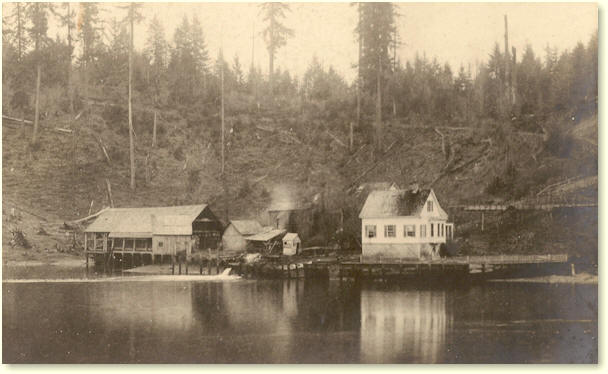
site of Olympia Brewery, c.1895 - image
Tannery and first residence, c.1895

1885 letter "Its the Water" - image


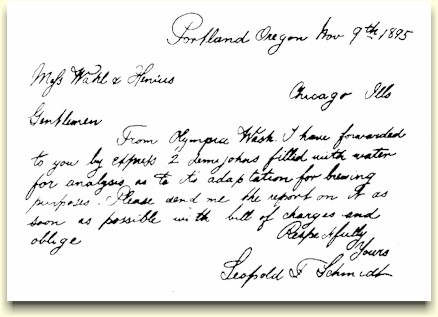
Eight weeks after purchasing the Tumwater property he sent a letter (at right) to the Whal-Henius Institute alerting them that he had sent them two demijohns of water for analysis.
 
The results confirmed what he already knew, and secure in the knowledge that - in his words: "with this water, I believe I can brew better beer than ever," he returned to Montana and sold all of his interest in the Centennial Brewing Company of Butte.


Capital Brewing Co.

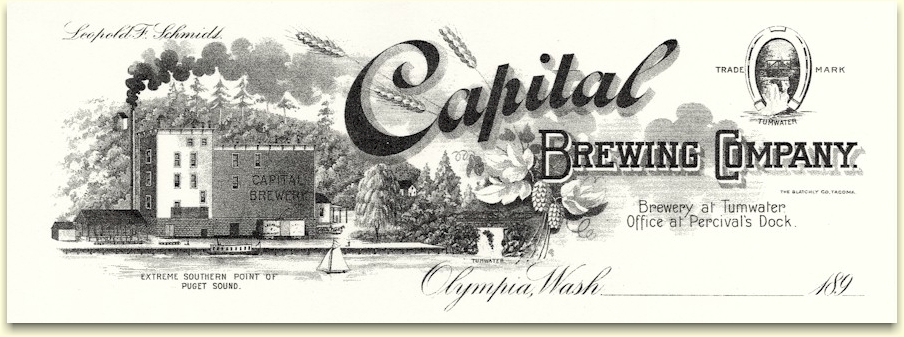
Capital Brewing Co. letterhead c.1900 - image
Capital brewing Co. letterhead, c.1900

The Capital Brewing Company

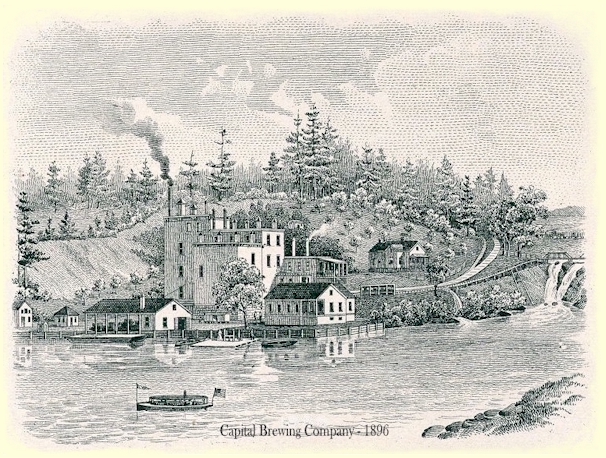
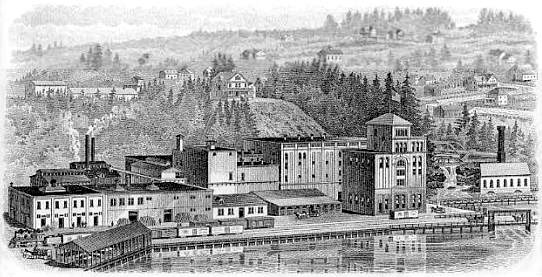
Etching of the Capital Brg. Co. c.1896 - image


The buildings of the Capital Brewery, constructed in 1896, behind the original residence and tannery, were built by Leopold F. Schmidt's brother, Louis. The new buildings included a four-story wooden brewhouse, a five-story cellar building, a one-story ice factory powered by the lower falls, and a bottling and keg plant.
 

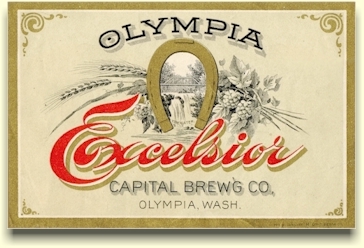
Excelsior Beer label, Capital Brg. Co. -  image
First label, 1896-1901

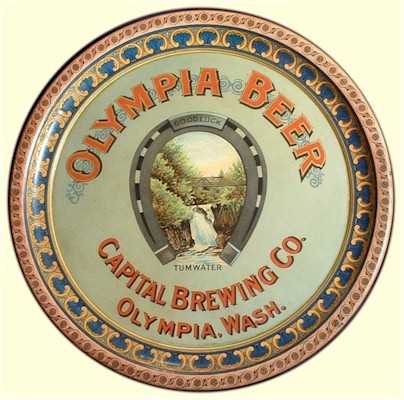
Capital Brewing Co. beer tray - image
Early tray, 1896-1901
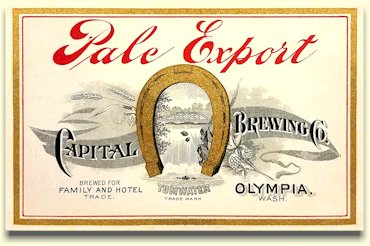
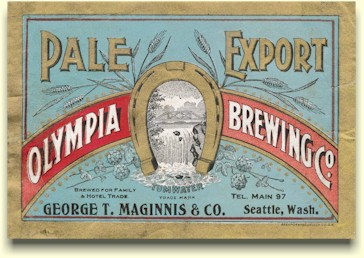
1902 Olympia Export beer label - image
1st Olympia Brg. label, c.1902


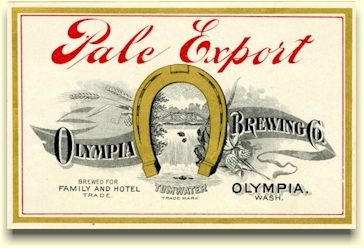
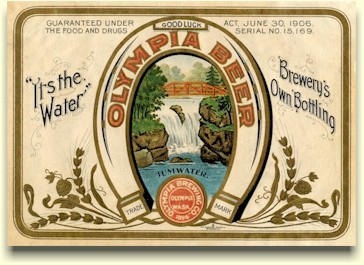
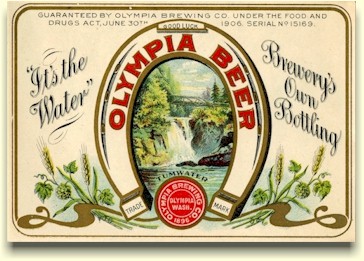
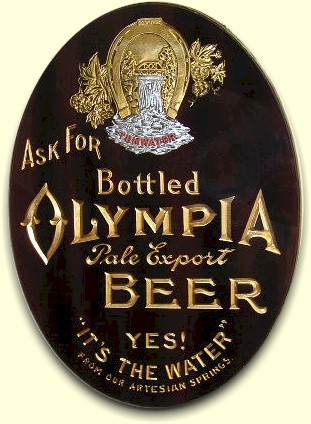
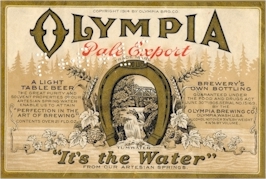
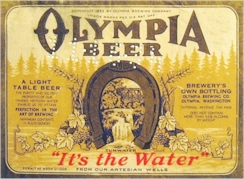
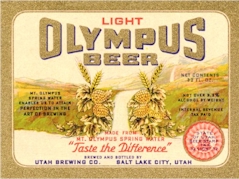
The Capital Brewing Company became the Olympia Brewing Co. in 1902, and at that time chose the slogan "It's the Water" for their flagship brand "Olympia Beer," in part to explain why the Tumwater lagers were so good. This was, in fact, the issue that prevented production of the "Olympia" brand at any of his other branches. They soon included the descriptor "export," as it inferred even higher quality, and their flagship brand became known as "Olympia Pale Export." The label (below) was copyrighted in 1914 and was re-instated after prohibition was repealed in 1933, and remained relatively unchanged. While imitation may be the highest form of flattery, I don't imagine that Olympia was flattered with the blatant copy of their label by the Utah Brewing Company of Salt Lake City (below), and I'm certain that they sued to terminate the use of the Olympus label.

Early Olympia Brg. Co. label, c.1906 - image
Early label, c. 1906
2nd Olympia Beer label, c.1906 - image
Another version, c.1906
Olympia Pale Export label, c.1914 - image
Olympia label, c.1914
Olympus Beer label from Utah Brg. Co. -  image
Olympus copy-cat label
 

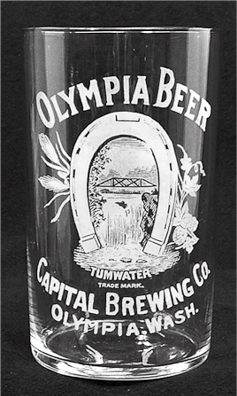
Olympia etched glass, c.1899 - image
Capital Brewing Co.
Etched glass, 1896-1901

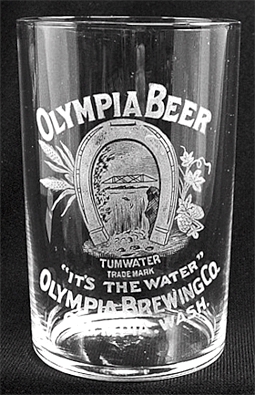
Olympia etched glass, c.1905 - image
Olympia Brewing Co.
Etched glass, post-1902

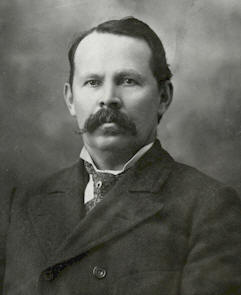
Leopold F. Schmidt was a pioneer of the multiple brewery concept, and with the Tumwater plant well established, he began construction on the Bellingham Bay Brewery, in 1901. He then established the Salem Brewery Association with the acquisition of the Capital Brewery of Salem, Ore., in 1902;  founded the Acme Brewing Company of San Francisco in 1906; and purchased the Port Townsend Brewing Company of Port Townsend, Wash., in 1909.  Early portrait of Leopold Schmidt - image

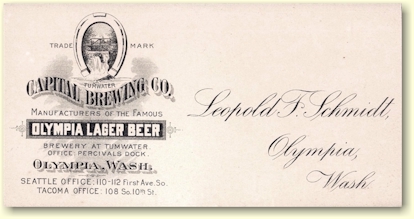
Leopold F. Schmidt's business card - image
Leopold Schmidt's business card, c.1898

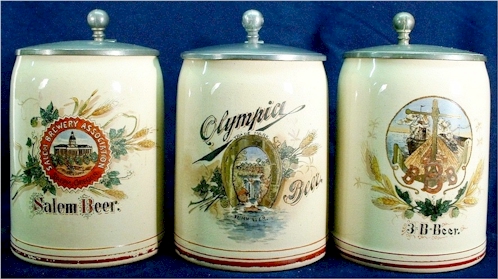
Salem, Olympia & Bellingham steins - image
Salem, Olympia & Bellingham steins, c. 1907


Ingraving of the 1906 Olympia Brewery - image

In 1906 the original wooden frame brewery was replaced by a six-story, Italianate structure made of Chehalis brick.
 
Sandstone for the foundation was brought in by wagon from a rock quarry at Tenino. Lumber from the areas of Hewitt and Wards Lake, four miles to the east, was brought to the construction site by six-horse team. Sand and gravel was hauled in by scow from Mud Bay spit and Tykle's Cove.


      OLYMPIA BREWERIANA - Pre-Prohibition

Olympia Beer stein, c.1913 - image
beer stein, c.1913 issued in San Francisco
 

tall Olympia Beer stein, c.1905 -  image
tall beer stein, c.1905

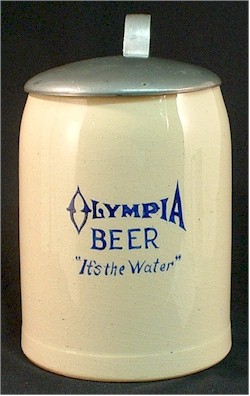
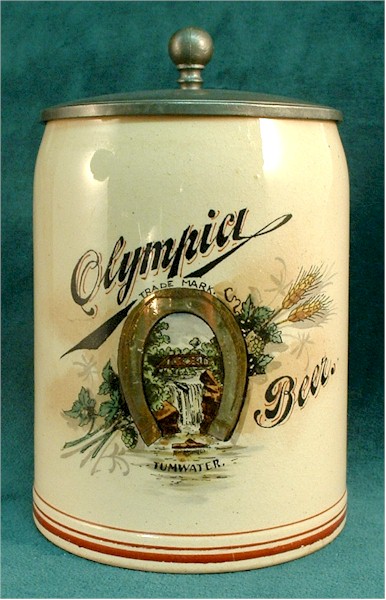
Olympia 1907 lidded beer stein - image
 lidded beer stein, c.1907
 
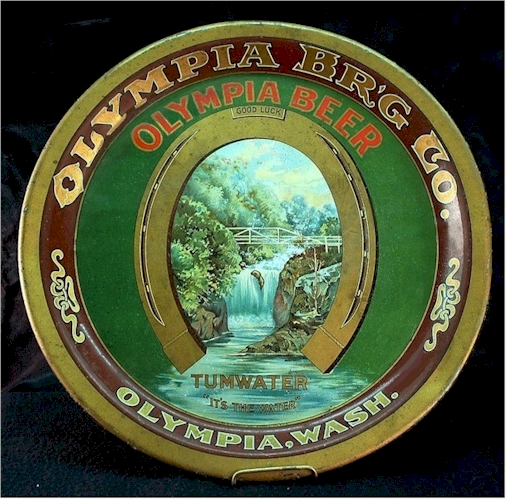
Oly Beer Tray - Olympia Blue -  image
the "Blue" Olympia beer tray
For Sale - TRAYS
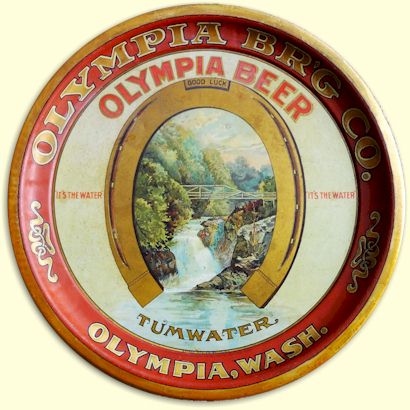
Olympia tip tray - image
 Olympia "tip" tray, Seattle branch
Oly Beer Tray - Olympia Green -  image
the "Green" Olympia beer tray
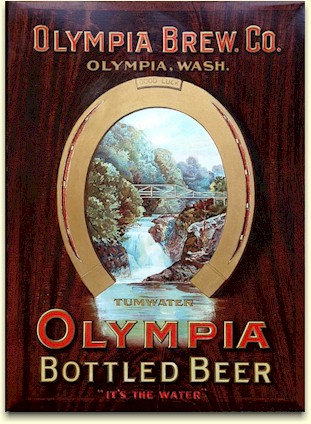
Olympia Bottled Beer, ROG lens - image
Olympia Beer, glass lens
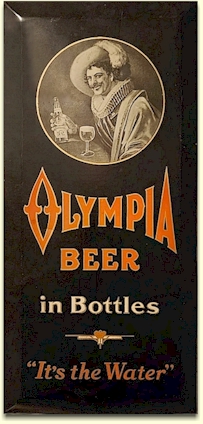
Olympia "Cavalier" beer tray -  image
Olympia "Cavalier" beer tray, c.1914
For Sale - TRAYS
Olympia Beer "Blue" charger -  image
18" Olympia Beer "charger"


State Prohibition

Leopold Schmidt died in 1914, just before prohibition forces triumphed in Washington and Oregon. The Olympia brewery group was then lead by Leopold's eldest son Peter. Prohibition came to Washington in Jan. 1916 - four years prior to national prohibition, yet the Schmidt family still had the two Acme plants in San Francisco where they continued to produce beer, but not Olympia Beer.

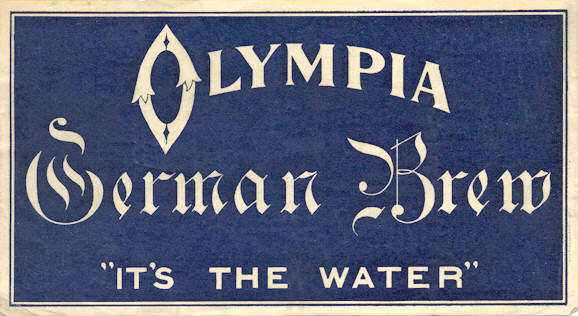
Brewing basically ceased in Washington in 1915, allowing brewers one year to depleteOlympia German Brew, beer label -  image their inventory and dismantle their operations. However, the Schmidt family chose to carry on with a near beers called "German Brew" (at right), "Lact Dark," an Olympia Malt Extract, and an Olympia Artesian Water. They also produced a slightly sparkling apple drink called "Applju" (see ad below).  It's slogan was "Drink an Apple" and they later made a heavily sparkling version they referred to as an "apple champagne."  A loganberry product called "Loju" was produced in their branch brewery in Salem.  Unfortunately, all fruit juice production was terminated in 1921 due to a sugar shortage caused by World War I in Europe. 

Ad for Applju and Lo-ju - image

In 1918, the Food Administration imposed a severe limitation on the use of sugar by less essential food products, which included soft drinks. This limitation failed to ease the sugar crisis, and in the latter part of 1918, a meeting was held by government officials for the purpose of declaring the soft drink industry non-essential and ordering it to be closed up for the duration of the war. Olympia struggled along with the sugar shortage for a few more years, competing with boot-leggers for the scarce commodity, but finally operations ceased and the Old Brewery was sold. It was then put to use as a paper pulp mill.

In 1918, the Food Administration imposed a severe limitation on the use of sugar by less essential food products, which included soft drinks. This limitation failed to ease the sugar crisis, and in the latter part of 1918, a meeting was held by government officials for the purpose of declaring the soft drink industry non-essential and ordering it to be closed up for the duration of the war. Olympia struggled along with the sugar shortage for a few more years, competing with boot-leggers for the scarce commodity, but finally operations ceased and the Old Brewery was sold. It was then put to use as a paper pulp mill.

With the advent of National Prohibition in 1920 the Schmidt family undertook many other business ventures, the most significant of which was their hotels. As a normal business practice many brewers had acquired saloons and hotels as exclusive outlets for their product. By the early 20's the Schmidt family controlled a large number of luxury hotels, with a presence in all of the major northwestern cities. So they decided to sell off all their inactive breweries and beverage operations (including the 1906 Tumwater Brewhouse), and concentrate on their Western Hotels chain. This would become the nucleus of the present day Westin Hotels.

They also started a bus transport business that would later become part of the Greyhound Bus Lines.


REPEAL of PROHIBITION
 

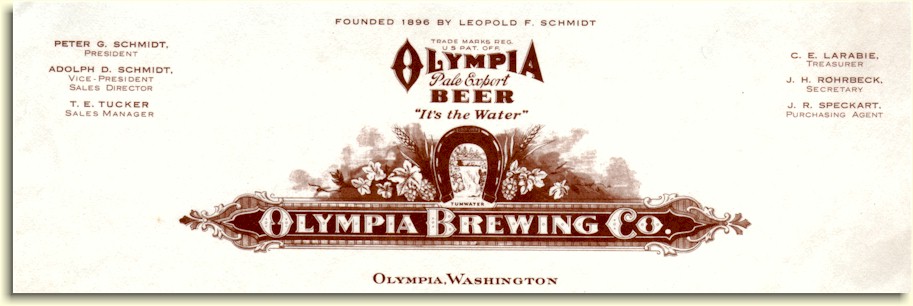
Olympia Brewing Co. 1934 letterhead - image
1934 letterhead
 

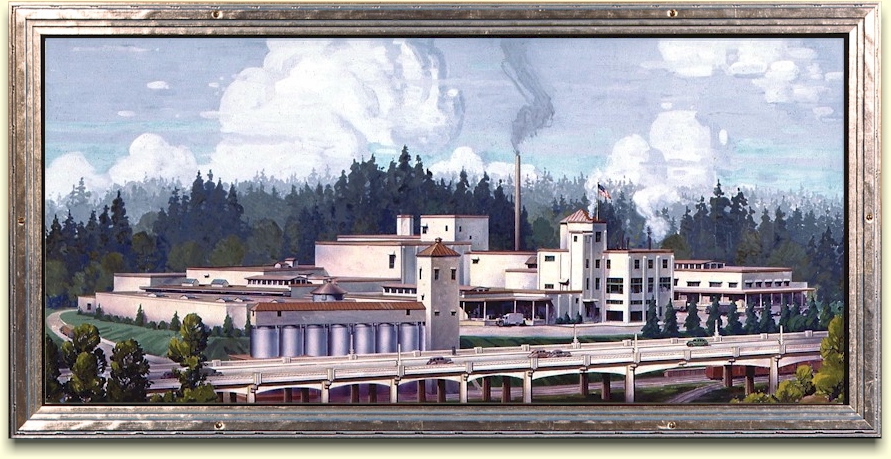
With Repeal of Prohibition in April of 1933, Peter Schmidt had only the Tumwater property and no brewery. He was faced with prospect of reacquiring the Old Brewhouse and undertaking a costly restoration and remodel. He decided instead to build a new, modern plant up on the hill above the original site.

With Repeal also came new legislation that forbad brewers from owning "tied houses" or any business that sold beer. Consequently they had to divest themselves of the hotels and concentrate on a single brewery in Tumwater. The plant was completed, and in on 14 January, 1934 "Olympia Beer" was back.

Olympia Beer stubby c.1935 - imageIn December of 1935, Olympia introduced a new bottle - the "stubby." This was a squat, no-deposit, no-return, 11 oz. bottle. It had the same capacity as the long neck but took up less room in the home refrigerator, and six-packs stacked nicely in grocery displays. Olympia was the first west coast brewery to adopt this style packaging, and with the added advantage of being a "no return" bottle there was no deposit required. This new package was quickly adopted by the majority of the breweries.

Sales were strong, and the brand was soon available in all of the western states, and by 1940, Olympia had surpassed its pre-prohibition production. The company stayed soley with draft and bottled beer until 1950. In August of that year they introduced their first canned beer (shown below). The can's graphics remained unchanged until the '60s when the zip-tab was introduced - and can openers became a thing of the past. 

After WWII the old brewhouse was being used by Western Metal Craft for cabinet manufacturing but were gone in the early '50s and it remained vacant. In 1964 the family repurchased the the old brewhouse and the other buildings on the water, and used them for storage.


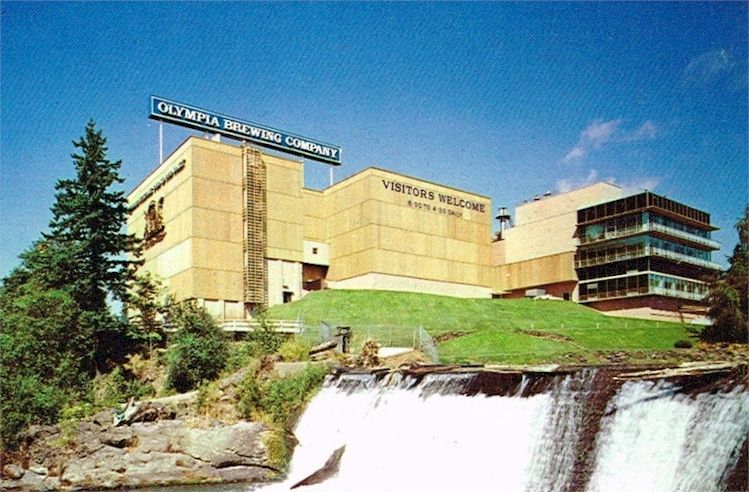
Olympia Brewing Co. c.1989 - image
Olympia Brewery c.1989


Olympia Breweriana - Post Prohibition


Olympia Beer can c.1955 - image
beer can c.1950


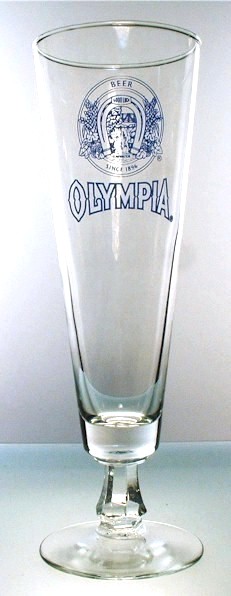
Olympia pilsner beer glass c.1950s - image

footed pilsner c.1950s


Olympia Beer test can c.1968 - image
test can c.1968


Olympia Beer embossed sign - image
embossed TOC sign


Olympia "stubby" beer stein - image
porcelain stein
 

Olympia Beer lighted sign - image
lighted ROG sign

Olympia Beer - ball tap knob - image
ball tap knob - enamel insert

Olympia Bock - aluminum beer sign - image
aluminum sign

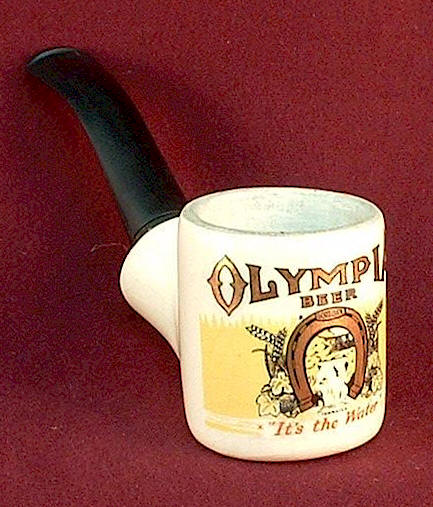
Olympia Beer ceramic pipe - image
ceramic pipe


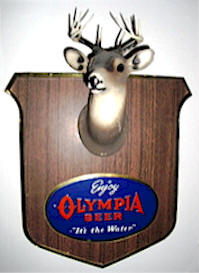
Olympia produced a great number of display items and signs through the '60s & '70s, which have become popular with collectors. They did two wild life series of wall plagues (below), the first of which was just the heads, and the second was of full figures. They also did a wildlife series of beer mugs which surprisingly didn't have "Olympia Beer" promptly displayed on them.

Olympia's Wildlife series 1- image

Olympia's Wildlife series 2 - image

In the '70s the brewery issued a series of re-prints of earlier lithographs (below). The most popular were the Capital Brewery, and 1907, 1909 and 1910 girls.  These reproductions were also decoupaged to old wooden slats to give them a more antique look. The two most popular images (Capital, and 1909) were also used on beer trays and other items that were sold in the brewery's gift shop.
 

Reprint of Capital Brg litho c.1900 - image
Reprint of  litho c.1900

Reprint of Olympia Brg litho c.1907 - image
Reprint of  litho c.1907

Reprint of Olympia Brg litho c.1909 - image
Reprint of  litho c.1909

Reprint of Olympia Brg. Co. litho c.1910
Reprint of  litho c.1910

Today

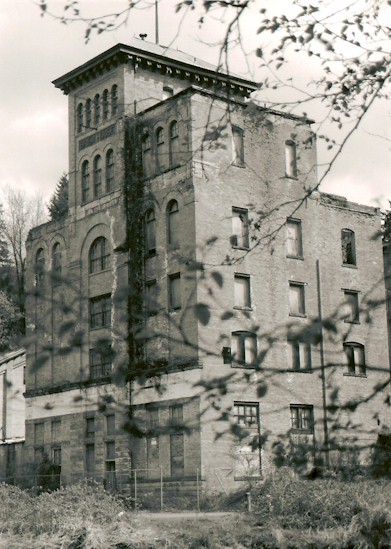
Olympia Brew House today - image
Brew House today -  K. Williams Collection


Today, the Old Brewhouse remains Tumwater’s best known landmark as part of Tumwater’s New Market Historic District, and is listed on the National and Washington Registers of Historic Places. While the structure is presently vacant and in deteriorating condition (see above), new owners had made plans for its restoration. Owner SABMiller closed the entire plant on July 1, 2003. The property was purchased by a bottled water company who had intended to market Tumwater's famous artesian water, but instead ended up in bankruptcy.

On 15 June, 2007 newspapers reported:

"The family-owned Benaroya Co. of Seattle has agreed to buy the former Miller brewery for $45 million, a deal with huge ramifications for the old brewery and the community if the deal wins bankruptcy approval.
The purchase agreement was included in a series of court motions filed this week to end the bankruptcy proceedings involving the 120-acre property now owned by All American Bottled Water Corp.
The sale is contingent on approval by U.S. Bankruptcy Judge Paul Snyder. He is scheduled to consider the motion July 5 in bankruptcy court in Tacoma."

Unfortunately, Three weeks after the encouraging news above, the Benaroya Co. pulled out of the deal to buy the old brewery complex. They learned the complex was too decrepit and part of the property is on a flood plain.

This is the latest blow to efforts to redevelop what was once a landmark in this town just south of the capital city. The future now looks bleak for the old brewery.

There is a Historic Preservation Program that hopes to save the old brew house. Check-out their web-site for additional information.

TheOldBrewhouse


Occasionally I'm asked if Olympia is still being brewed. The answer is yes and no! Of course there is no longer beer flowing from the Tumwater plant, however the Pabst Brewing Co. still owns and markets the brand. Currently the Miller Brewing Co. has been contracted to produce Olympia Beer in their Irwindale, CA plant for Pabst. So yes, you can still get an Oly! But only in these Western States - AZ, CA, HI, ID, MT, OK, OR, UT, WA, & WY. Check the "Locator" to see if it's available in your area.


OLYMPIA COLLECTIBLES - For Sale 


Olympia beer glass c.1902 - image

Pre-Prohibition etched beer glass, c.1902. Go to: Glasses

Olympia Beer glass, tall pilsner - image

Three different post Prohibition Olympia beer glasses. Go to: Glasses

Olympia lidded beer stein - image

 Olympia Beer stein, a re-issue of the 1907 original. Go to: STEINS

Olympia Beer tray, c.1905 - "the Blue Olympia" - image

Two Pre-Prohibition Beer trays. Go to: TRAYS

Olympia miniature mug - image
 

A miniature mug, and three different Olympia embroidered patches for jackets or hats. Go to: MISC.


Olympia Brewing Co. Research ongoing ......
More to come.


All contents including images are copyright by BreweryGems.com
 and can not be used without permission from BreweryGems.
Copyright © 2004 ~ All Rights Reserved.


Acknowledgements

  • Thanks to Bryan Anderson for supplying the images of the three early labels and the early Capital Brewing tray.
     

  • And to photographer Kaisa Williams for her image of the Old Brew House.
     

  • Thanks to Bill Mugrage for his images of Leopold's business card, the German Brew label, glass lens, and 18" charger.
     

  • To Dave Unwin for the photo of the tannery and first residence.


    For any comments, additions, or corrections - or if you have brewery items for sale -
    please contact me:


    Gary@BreweryGems.com
     

  • BREWERIANA | BREWERY HISTORIES | SITE MAP | ABOUT ME | CONTACT