BREWERY GEMS PROFILES:
Armin Neubert - Brewer

ARMIN LOUIS NEUBERT (1864-1946)
Armin L. Neubert was born the 2nd of August, 1864, son of Dr. Louis and Amalie Neubert of Wolkenstein, Saxony, Germany. In 1869 Dr. Neubert died suddenly of pneumonia, leaving a widow and five young children. Amalie did eventually remarried, becoming Mrs. Fischer of Freiberg. At the age of 12 Armin moved in with an uncle who was operating a casting foundry, machine shop, and gun smith shop in Linbach, Saxony. This move allowed the young Armin the opportunity to attend advanced, continuing education not available in his home town, and to avoid working in his step-father's fish farm.
His guardian uncle (his father's brother) had no children and hoped that his ward would continue to apprentice, and eventually assume his business. However, Armin had no interest in metal working, nor in fish farming. Instead, he had aspirations to become a brewer. His uncle finally relented and, concurrent with his normal schooling, he took brewing courses at a brewery in Liberstein. In 1881, at the age of 17, he graduated from his schooling and was on his own.
He then commenced a series of short apprenticeships. From 1881 through 1885 he gained experience in a great number of brewing procedures that were at that time predominately manual, with little or no mechanization. He worked first at the Ribeck & Co. brewery in Leipzig. Then in 1882-83, he worked at the F. Strigler Dampf Brewery in Halberstadt, and at Bülow & Revers' Radau Brewery in Harzburg. Also in Harzburg, in '83-'84, he worked at Wietig's Brewery. He then made, what latter would be deemed a poor decision. He left the country and went to Holland to work at the Heineken's Brewery in Amsterdam. By 1885 he was back for a stint with Müser's Export Beer Brewery in Largendreer, and then with the Tivoli Brewery in Berlin.
In November of 1885 he began what should have been two years of compulsory service in the German-Saxon Army. However, due to his undocumented sojourn in Holland, and a tardy registration, he was to complete three years of service.
Upon his discharge, and after a farewell visit with his family, Armin followed his uncle to the United States. His former guardian had set up his foundry business in Brooklyn. But before joining his uncle, he reverted to his interest in brewing and traveled to Washington, D.C. were he apprenticed at the Christian Heurich Brewery for two months. This was followed in the Spring of '89 by another couple of months at the Christian Moerlelin Brewery in Cincinnati, Ohio.
Armin next headed to Boston for an eight month tour at William Smith & Co's Revere Brewery, followed in Jan. 1890 with a short stint at the Roessle Brewery in the Roxbury Dist. of Boston. But responding to a request for assistance, Armin went to Brooklyn and spent two years doing castings in his uncle's art foundry. However, he did not abandon his ambitions to become a brewer. During this period he attended night school, and when he left the foundry he entered the prestigious Schwartz Brewing Academy. He graduated with honors in early 1892. One of his a classmates, who's friendship would prove fortuitous, was Sigmund F. Wiedenbeck.
While Armin was a dedicated student, he did find time for other interests. He became enamored with a Miss Frieda Schaller. Frieda was born on 5 May, 1876 in Berlin, daughter of Robert Schaller, who was then employed as a printer for the Wall street Journal. However, given Armin's apparent inability to maintain steady employment, he was not considered a likely prospect for marriage. Consequently, upon completion of brewers school, Freida and Armin were secretly married. The plan was for Freida to join him upon his securing permanent employment, and the parent's approval.
Later that year ('92), Armin traveled to Minnesota to accept a position at the Minneapolis Brewing Co., acquired through the efforts of his old classmate Sigmund Wiedenbeck. But owing to his strategy of acquiring various brewing skills through numerous apprenticeships, his work record in those endeavors, plus his outstanding performance at the Schwartz Academy, Armin became a hot prospect in his chosen industry. In early '93, he received an offer for the position of brewmaster at the Rheinlander Brewing Co. in Wisconsin. He accepted the offer, and was soon joined by Freida, with her family's blessing.
The Armin Neubert family had hardly settled in Wisconsin when a better offer was received from the Baier & Ohlendorf Brewery in Freeport, Illinois. Two months after their arrival in Freeport, Frieda gave birth to their first child, Armin Karl Neubert, on 1 January 1894. Once on the job, Armin found the plant's production in a sorry state, with an output of only 265 barrels per month. He set about to correct matters, and his efforts were soon exceeding expectations. By July of the following year, in a mere eight months, he had increased production nearly six fold, to 1500 barrels per month!
When the Minneapolis Brewing Co. learned of his achievement - no
doubt thanks to his friend Wiedenback - Armin was offered the top position of
Production Superintendent of this first rank brewery. Henry Baier offered to
make Armin a partner if he would stay on in Freeport, but the Minnesota offer
was too good to pass up. He was to stay with the Minneapolis Brewing Co. for 20
years - from 1894 to 1914. It was in Minneapolis that he would also see his
family flourish. His second child, Elsie was born on 12 May, 1896. And on the
1st of December 1913, his third child, Francis was born.
Another milestone in Armin's career occurred in 1907. In December of that year
he was elected president of the newly formed, northwest chapter of the Master
Brewers Association of America. He was proud to serve in that office, and to
receive recognition from the elite of his chosen industry.
In 1895, the year after Armin took over production, Grain Belt
Beer was introduced, and it remained the brewery's flagship brand from then on.
Also in that year some principals in the brewery were looking at a plant in
Central City, South Dakota that had been closed due to statewide Prohibition.
However, SD Prohibition was to be repealed, effective in 1896. So, they
purchased controlling interest of the Black Hills Brewing & Malting Co., and
made plans to reopen the plant.
Central City is in the Black Hills region of SD and is located about two
miles SW of Deadwood. There were also a few other small communities, built
around the booming mining industry.
In 1900, additional Minneapolis investors got involved and the necessary capital was raised for a new plant and bottling works. The brew house was to incorporate the patented Neubert design, which had been adopted by numerous plants in the U.S., Mexico, and Asia. The principals in the new company were: Armin's old friend, Sigmund F. Wiedenbeck, president; Armin Neubert, vice-president; G. J. Heinrich, secretary; and H. B. Schlichting, treasurer & manager.
They retained the name Black Hills Brewing Co., merely dropping the word "Malting" since they were now purchasing their malted barley from Minneapolis. They also kept the established brand name of the old brewery - "Gold Nugget Beer."
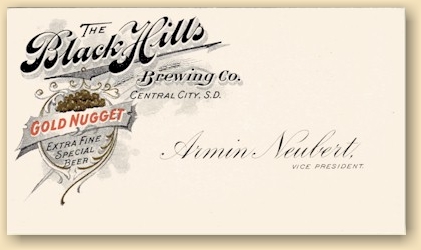
Armin, of course, was in charge of production and frequently made the 650 mile railroad trip between Minneapolis and Central City. Since some principal shareholders of the Minneapolis Brg. Co. also had a stake in the Black Hill brewery, this was a satisfactory arrangement. He even took extend stays in Deadwood in 1913 & 1914. However, late in '14, Armin retired from the Minneapolis Brg. Co., and made the trip to Central City with the entire family, taking up residence and a more active role in the plant's production. At this time he also began a long time friendship with a Dr. Fehliman from lead City, who would later invest in a California business venture with Armin.
In 1916 things took a turn for the worse. South Dakota legislators adopted constitutional state Prohibition, to take effect on January 1, 1917, three years ahead of national Prohibition. So, in 1917, the Black Hills Brewing Company began doing business as the Black Hills Products Co., producing soft drinks and a low alcohol near-beer called "Byro."
Not long after Prohibition took effect, the plant's manager - Herbert Schlichting, had a run-in with federal liquor enforcement agents. One of the beverages being produced was too strong and had to be dumped. The story is still being told of the day Deadwood Creek flowed with foamy beer. By now Schlichting had had enough and left for California, and Armin took over as general manager.
The company struggled on with the introduction of a ginger ale, and re-formulated "Byro." Then in May of 1926, Armin's old friend, and president of the company, Sigmund Wiedenbeck, died. Armin then became president and principal shareholder of the Black Hills Brewery. But his presidency was to be short lived. After another run-in with federal agents over his "Byro" being too strong, Armin too, had had enough. Exasperated with the beleaguered state of his beloved industry, and with no expectation that national Prohibition would soon end, Armin closed the plant in 1927, and sold it the following year.
He then removed to his property near Great Falls, Montana, and took up ranching and wheat farming. After a few years he turned the ranch over to his son and retired to Santa Cruz, CA.
But Armin was soon to be drawn back to his chosen field. In 1933, an ex-apprentice from his Minneapolis brewing days contacted him about a design project. JP Rettenmayer, and some principals from the Olympia Brg. Co., were planning to erect a brewery in Oakland, CA. Knowing of his expertise in brew house design, they wanted Armin to work on their project. However, sufficient capital for the planned Samarkand Brewery could not be raised, and the project was scrapped.
But other entrepreneurs were also seeking to enter the beer business. George Silver and Max Bayha, both with ties to the Nehi Corporation, raised the necessary investment capital to purchase the old Salinas Brewery, and persuaded Armin and his son to get involved.
Armin was to receive equity in the new company as payment for his engineering work, and his son, Armin K., who had an engineering degree, was included in the deal. The Salinas Brewing & Ice Company was opened and soon gaining recognition for its excellent "Monterey Beer." Armin, Sr. was brewmaster, and Armin, Jr. was the treasurer of the firm.
Within a year the firm was struggling and in November, 1934, JP Rettenmayer (past presidentof the Acme Brewing Co.) was hired as general manager of the brewery. When Armin, Sr. retired in 1936, JP purchased his shares and assumed the position of president and general manager.
Then in February of 1937, Rettenmayer met with an untimely death, followed in November by the death of a prime stockholder and director of the company, Dr. Wm. Fehliman. This resulted in the restructuring of the company in 1938, and the Neubert family gaining sole control. The company's name was changed to the Monterey Brewing Co., with Armin, Jr., president.
It was to be a family affair. Armin, Sr. took a less active role, but still drove from Santa Cruz weekly to check on production. His oldest daughter, Elsie, now Mrs. Hanibal Trucano, had held the position of secretary in the last days of the Black Hills Brewery. The Trucanos had traveled from South Dakota to again help the family. Elsie by assuming the secretary position, and her husband taking the job of Bottling Works supervisor. The company's brewmaster was George Ziegler, who had married Armin's youngest daughter, Francine. However, the issue of brewmaster caused some family discord. Armin was to chose one of the son-in-laws to attend the Brewer's Academy, and Hanibal being the oldest felt that it was fitting that he be chosen. Ultimately George became brewmaster with positional authority over Hanibal and the bottling works.
Four years later the issue over who was brewmaster became moot. The brewing industry was beset with difficulties due to shortages and rationing of raw materials for the war effort. The family struggled to make the business profitable but after four lean years, and in spite of the Neubert family's best efforts, the brewery ceased production. In 1942 they reluctantly converted the brewery into a cold storage operation.
Armin Louis Neubert died four years later on 3 July, 1946. He
was well remembered as one of the last pioneers of the brewing industry.
ACKNOWLEDGEMENTS - A special thanks to Neubert family for sharing their family history.
For any comments, additions, or corrections please contact me:

Copyright © 2006 by BreweryGems ~ All Rights Reserved.
