
and successors
Columbia Breweries, Inc. (1933 - 1953)
Emil Kliese was a 35 year old, German-born brewmaster who had emigrated in 1883, and by 1890 was working at a brewery in St. Louis. In the mid-1890's, Kliese made his way west securing a position with the newly established Capital Brewing Co. (later the Olympia Brg. Co.) in Tumwater, WA. By 1899 he was their head brewmaster. A business opportunity arose when some Tacoma investors wanted to open another brewery in that town. They required an expert brewmaster, and he wanted to operate his own brewery. So he, along with, William C. Kiltz, filled for articles of incorporation on the 8th of February, 1900 "to brew and sell at wholesale and retail beer and other malt beverages" at a company to be known as the Columbia Brewing Company. The new firm had an initial capitalization of $50,000. William Kiltz was sales manager and Emile Kliese was owner, president and brewmaster. The brewery's start-up was aided by the larger Pacific Brewing & Malting, a major shareholder. By 1906 it controlled Columbia, but allowed it to operate independently and market its own brands of beer.
Tacoma's newest brewery was on line
by the end of April, 1901, at which time the city boasted of 95 bars. |
 |
 |


reverse-on-glass "lens"
|
|
|

Columbia Brewing Co. bottle cap
lifter, ca.1910

|
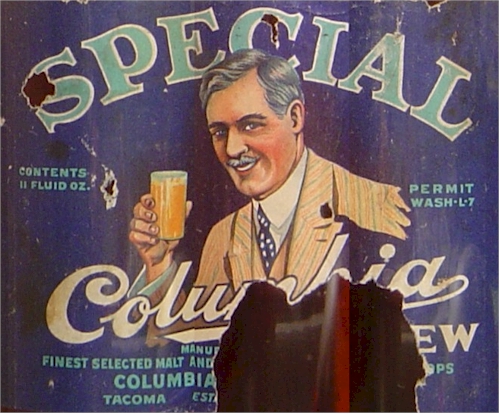
As can be seen on the trays, glass, and label (above) the brewery had a number of brands of beer, Columbia, Golden Drop, Golden Foam and Old Pilsner. They were also shipping their beer to the San Francisco market to help with the shortages resulting from lost production after the 1906 Fire & Earthquake. Rather than ship bottled beer they found a bottler that escaped destruction - the North Star Bottling Works.
Their logo featured the figure of Columbia who was also referred to as Lady Liberty and was often pictured in a patriotic mode. Columbia was also used to represent bounty and prosperity, and we see both representations in the trays and etched glass (above). Then in September of 1912 they added Alt Heidelberg [Old Heidelberg] to their line-up.
|

PROHIBITION - 1916
|
The Columbia Bottling Company (1916-1921)
Emile Kliese's younger brother, Paul, succeeded him as the
brewmaster at Columbia in 1918, and Emile died the following year. The Kliese family sold their shares in the Columbia Bottling Co. in early 1921. The company was then re-organized as the Columbia Brewing Company.
Otto Birkmaier remained in the position of brewmaster until his death in June of 1945. During his lifetime he was one of the most highly regarded brewers in the country. Another employee that would devote many years to the brewery was Albrecht "Alfred" Messmer. Alfred immigrated from Germany in 1923 and by 1930 was a machinist for Columbia. He aided brewmaster & engineer, Birkmaier, in the expansion plan set in motion two years later by the brewery's new owner. A master machinist and engineer in his own right, Messmer would oversee numerous projects over the following 35 years as plant engineer. |

letterhead, ca.1945
|
|
|
|
|
In 1935 Hemrich introduced a label with a side view of the Student Prince, copied from Biber's sculpted freize (above), and dropped the pre-prohibition style labels. This label was also used on their 22 oz. bottles which were a standard size used prior to Prohibition.
In October of 1935, Hemrich sold
his controlling interest in the brewery to Joseph F. Lanser, one of the
original investors. Elmer then started his own business in Tacoma as a contract
brewer d.b.a.,
Elmer E. Hemrich's
Brewery, Inc.
In February of 1936, Columbia was the first Pacific Northwest brewery to introduce canned beer. It was named Alt Heidelberg Guest Beer (at right), and as explained on the back of the can: "...here is a beer just as you would taste it as a guest in our brewery..." Another beer the company canned was Finer Flaver Ale. This brand was produced for a food market chain owned by the West Coast Grocery Co. of Santa Monica & L.A. The following year the contract was taken over by the Monarch Brewing Co. of L.A. About 1938 saw another new beer added to the Columbia line-up. It was called Atlas Beer. It doesn't appear to have been a strong seller, and in 1940 they changed the name to "Atlast" but that didn't seem to help and it soon disappeared. There's probably a story behind the brand name, but I've yet to learn the details.
In 1939 Norman Davis replaced Joseph Lancer as president of the brewery. Lancer stayed on until '42. He then sold his share of the company and left for Phoenix where he purchased controlling interest in the Arizona Brewing Co. - brewers of A-1 Beer. Coincidentally, his A-1 plant would be purchased in '64 by the Carling Brewing Co. after first taking over his old Tacoma plant. |

20" x 12" drawing of the Columbia
Brewery, ca.1941
|
One of Davis' early decisions was to discontinue the faltering Atlast brand in '41. However, he did find a replacement in the product line with the introduction of an entirely new style of beer. Columbia Ale made its debut in that year.
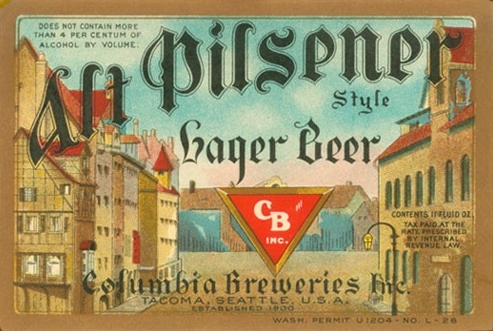
Brewmaster Birkmaier developed the ale, which was a top fermenting beer, and a first for the brewery. The old English style Ale immediately gained a following and remained a popular seller for 17 years. When Carling purchased the brewery in 1958 they discontinued the product and replaced it with their Red Cap Ale, but the new ale never sold as well as Birkmaier's. Otto died in 1945 and was succeeded by Anders W. Erikson. With the country at war with Germany it was decided to re-introduce the figure of Columbia, but in her most patriotic incarnation - the Statue of Liberty (below left). So, this image was to grace their new Columbia Ale and Beer labels. They also played down the Germanic figure of the Student Prince by reducing his image on the Alt Heidelberg labels (below right). |
|
|
|

Another product made its appearance
in the in the '40s, although infrequently. The Export Beer label
(above) that introduced the "Lady Liberty" motif was soon
updated with metallic gold & silver borders, and the slogan: "Toast
of the Coast." (below) |
|
|
|
|
|

|
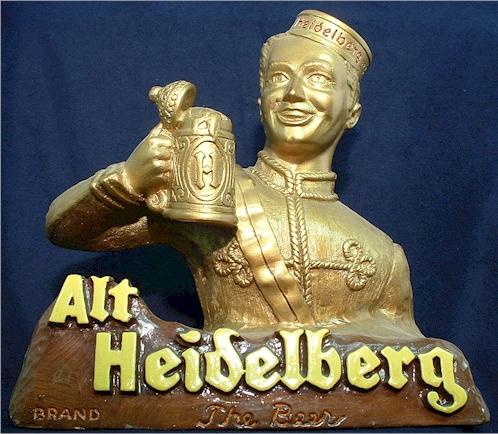
Heidelberg Brewing CompanyIn 1949, Columbia Breweries, Inc. was restructured, changing its name to the Heidelberg Brewing Co., but choosing to continue doing business as Columbia Breweries. On July 15, 1953, the brewery officially adopted the name of Heidelberg Brewing Company. At this time they chose to drop the "Alt" from their flagship brand simplifying it to just Heidelberg Beer. This recognized their adherence to newer brewing practices and doing away with the "old" or alt. The late '40s and early '50s saw a huge growth in sales, due in part to the vigorous advertising campaign that sought to blanket the Northwest with the image of the Student Prince. The figure (below) leapt out at you from billboards and print media. 
Below are a few examples of promotional pieces from the late '30s and
'40s...
...and the '50s.
The year 1954 began another period of expansion with the installation of
a second brewing line and additional storage tanks in a four story
addition. The new cellar had storage for over ½ million gallons of beer
for aging. The brewery now had triple the capacity that it had in 1947,
at 750,000 barrel/year. Heidelberg was now the largest brewery north of
San Francisco and west of Milwaukee. In 1958 Carling Brewing Co. of Canada purchased the Heidelberg Brewing Co. for $3,500,000. This added Carling Black Label, and Red Cap Ale to the line-up, and ended Columbia Ale - but not Columbia Beer. However, Heidelberg Beer remained its best seller.
Since 1956 Carling had been licensed to brew and market the Danish beer, Tuborg, and had been producing it at their Natick, MA plant. Then from '73 to '75 the company also brewed Tuborg in both their Baltimore and Tacoma plants. During this period the Heidelberg Brewery was also doing business as the Tuborg Brewing Company.
In 1976 Carling of Canada sold their American Division which then merged with the National Brewing Co. of Baltimore, creating Carling-National Breweries, Inc. Three years later Carling-National was purchased by the G. Heileman Brewing Co. of La Crosse, WI. Prior to the purchase of the Heidelberg Brewery, Heileman had acquired the Rainier Brewing Co, in Seattle. Unfortunately this multiple acquisition ran afoul of the antitrust laws. Owning two major plants in such close proximity gave Heileman too large a share of the regional market, and they were forced to close one of the plants. So, in the Spring of 1979, after 3/4 of a century of brewing in Tacoma, the old Columbia Brewery closed its doors for good.
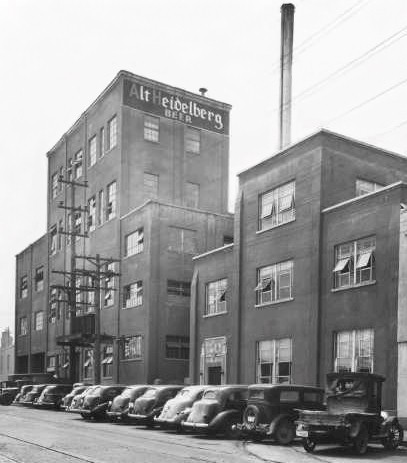
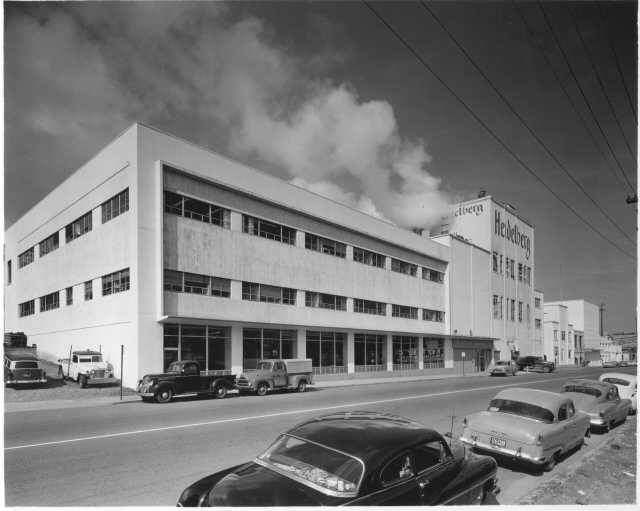
For over 30 years the brewery laid vacant and decaying. There had been plans to
transform the Heidelberg Brewery into a hotel,
but this never came to pass.
FOOTNOTE: ¹ Elmer Jakeway returned to Ketchikan and was hired as manager of the Pilsener Brewing Company, a position he held until the brewery closed in 1942.
Article By
|
HEIDELBERG
COLLECTIBLES - For Sale
|
|
Four different Columbia labels from the 40's. Go to: MISC |
|
WARNING -
I've seen phony match safes from seven
different WA breweries - all with graphics taken from my history
pages. The fakes I'm aware of are supposedly from: Hemrich
Bros. Brewing Co.; Seattle
Brewing & Malting; Bellingham
Bay Brewery; Aberdeen Brewing Co.; Albert Braun Brewing Assn.;
Columbia Brewing Co.; and the Washington Brewing Co. of Everett.
|
|
For any comments, additions, or corrections -
|










 Carling
then made a further move to modernize the Heidelberg label by
introducing a rounded triangle shaped border, with the Student Prince
reduced even further (at right). By 1965 the image of the popular
figure was dropped entirely.
Carling
then made a further move to modernize the Heidelberg label by
introducing a rounded triangle shaped border, with the Student Prince
reduced even further (at right). By 1965 the image of the popular
figure was dropped entirely. 


